
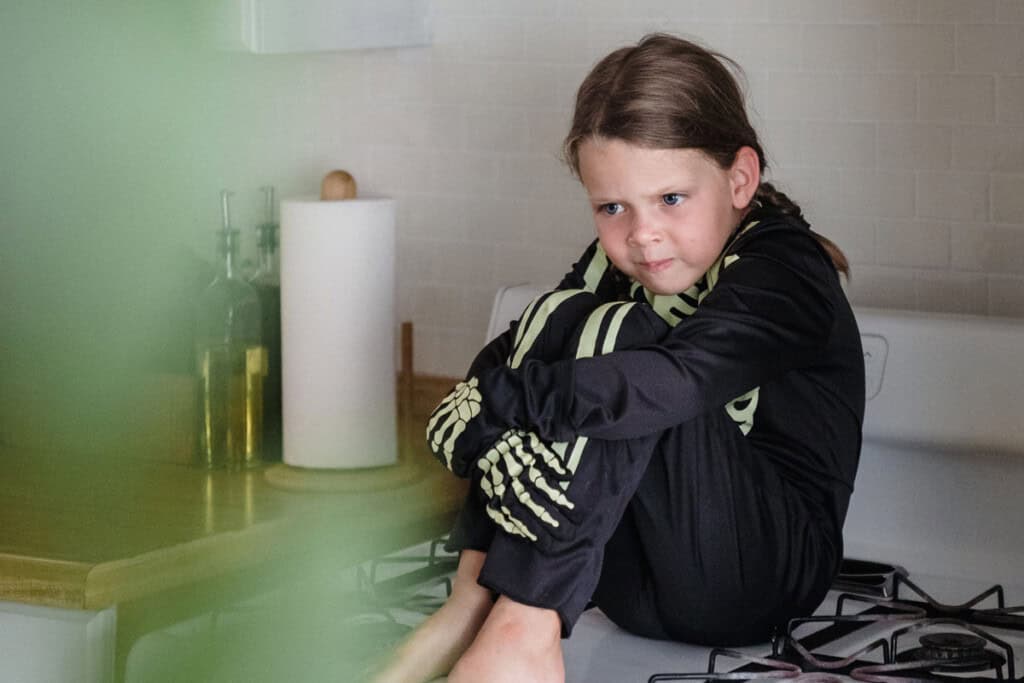
Why are some children extremely sensitive? And what can parents do to help their sensitive child navigate the seemingly scary world around them?
October ushers in all kinds of scary and spooky sights and sounds. Horror movies flood all the television subscription platforms. Suburban neighborhood homes transform into graveyards with other eerie phenomena, like witches cackling or creaky doors opening. Festive yet frightening.
Another scary situation? When sensitive children hear critical comments targeting them for some reason. Warranted or not.
Some children, especially neurodivergent ones, can be emotionally hurt by critical comments. Labels and derogatory words have a long shelf life in many kids!
This writer has heard: “You are a (gosh darned) dummy” too many times as a child to remember. The volume of the voice in my head has lowered, but it still echoes in my thoughts. This has lasted decades!
These attacks – this is what it feels like to sensitive kids – lead to some lingering negative effects that can quickly morph and cement into shame.
Shame sticks with people. It turns into armor, like a turtle shell, where the person retreats and essentially hides and waits for safety. It can also turn into a weapon. Shame can create aggression and anger towards a particular – and often innocent – target. Shame has no rules of engagement and does not stay within the lines.
Many ADHD and autistic children share this under-recognized trait of feeling deeply, being overly sensitive, and taking even simple redirection as a personal attack. What is the answer? Simple in theory but challenging in reality.
Watch your words and read on!
Traits of highly sensitive children
If you are a parent of a neurodivergent child and are reading this, you may be saying to yourself, “My goodness, this explains so much.” Clearly every child is unique. However, kids who are highly sensitive to the world around them share six traits, according to Neurodivergent Insights.
Emotional sensitivity: extreme emotional response to various stimuli
Deeply empathetic: heightened understanding of other’s feelings
Subtle awareness: sharp perception on surrounding details
Sensitivity to environment: strong reactions to their surroundings
Sensory overwhelm: becomes easily overloaded due to sensory input
Affect contagion: strongly influenced by the emotions around them
While the overwhelming majority of these children are neurodivergent – autism, ADHD, etc. – neurotypical kids can exhibit these same traits. And as a discerning eye can see, there is overlap between these six traits. The bottom line: highly sensitive children are deeply affected by the world around them.
Why critical comments deeply hurt some people
It is a great question: Why do some kids become more deeply hurt by critical comments than some of their peers? Environment? Genetics? Here are some possible reasons.
Rejection sensitive dysphoria (RSD) is an extreme emotional or physical pain caused by a real or perceived rejection, criticism, or failure, according to the Autistic Girls Network. It can produce feelings of pain, shame, and or anxiety. RSD is experienced by people with autism, but also can extend to other populations such as individuals with ADHD.
Traits shared by people with RSD include people pleasing, reassurance seeking, perfectionism, and or a fear of disappointing others. Parents, do any of these sound familiar? If so, watch your words.
Some children have Sensory Processing Sensitivity, which affects about 15% to 20% of the population, according to Science Direct. These children experience deep processing, meaning they perceive facial cues and tone of voice much more deeply than the average child. Plus these same kids can experience emotion reactivity, which means they experience emotions – both positive and negative – much more intensely. A critical comment can feel like a physical punch.
Yet another reason some kids are wounded by words is due to a history of correction. Neurodivergent kids tend to receive way more behavior corrections than praise compared to their neurotypical peers, and this imbalance of negative comments to positive ones can simply open wounds and scabs developed from the onslaught of perceived criticism.
Finally, there may be an underlying (undiagnosed) mental health condition, such as depression and/or anxiety. Children who are suffering from a mental health condition more than likely have a negative self-image, and any comments, no matter how innocuous, can feel like an attack.
How to help your sensitive child cope
Just as there are many reasons why a child is highly sensitive, there are many ways to help support them.
Acknowledge their feelings: Help your child name the emotion they are feeling, and equally as important, do so without judgment. I see you are feeling angry. This lets your child know they are being heard and understood.
Develop a calm and structured routine at home: While a highly sensitive child can meltdown anywhere at any time, a common time and place is at home, right after school. By establishing a consistent routine that your child can depend on, you are providing a safe space for your child to return to each day. Their sense of security increases while their anxiety deceases.
Teach emotional regulation: Directly teach your child different techniques that help them calm down. Breathing exercises, simple yoga poses or time lying quietly on a mat, or placing a weighted blanket on themselves are all great self-regulation strategies. Bring the nervous system back to baseline.
Teach self-advocacy skills: Because highly sensitive kids tend to be people pleasers, it is important that you help your child learn how to self-advocate.Essentially, you are teaching your child how to communicate their needs and boundaries in an effective way. A great low-pressure way to develop this is through role playing at home. Pretend to be your child’s teacher and have them ask you for something. Rehearsal will boost confidence and independence.
Develop self-awareness: Help your child learn their triggers. Is it crowded locations? Extremely loud situations? Comments from an authority figure, that are truly meant to help, but seemingly come across as personal attacks? Work with your child to develop an awareness of what sets them off, and then make a plan to help diffuse these situations.
Connection before correction: Without hesitation, even as your child may be exhibiting a torrent of emotions, tell them you love them before you try to intervene. Simple phrases like I am here with you; or You are an amazing person can go a long way to establishing connection before you begin to try troubleshoot or course correct.
Build them up (not toughen them up): Perhaps a well-meaning relative has uttered the phrase, “You need to toughen him up” about your sensitive child. Unfortunately, this does not work. Rather, feed child your child positive reinforcement when they produce a good outcome. Recognize and acknowledge that they went to their room and listened to music rather scream at an annoying sibling. The goal is to build confidence and agency so that they will rely on positive coping techniques rather than devolving into risky behavior or less desirable alternatives.
Final thoughts
During the month of October, scary and spooky events and decorations tend to permeate the landscape. Which makes it a perfect time to help parents – and any adult who works with children – remember that scary and intimidating words can damage sensitive children. These kids tend to tune into the environment around them with eagle eyes, elephant’s ears, and CIA agent’s empathetic accuracy. By acknowledging their feelings, teaching emotional regulation and self-advocacy skills, and most importantly, connecting with your child before correction, you will help them navigate this big, beautiful, and sometimes scary world. The goal is to build agency and confidence, not a perception of defectiveness, leaving the child feeling like something is wrong with them.
If you have an overly sensitive child that becomes easily upset by criticism and or perceived negative comments, contact Jennifer Disch at Engage the Brain to discover how an Executive Functions coach could help teach your child these critical skills.