
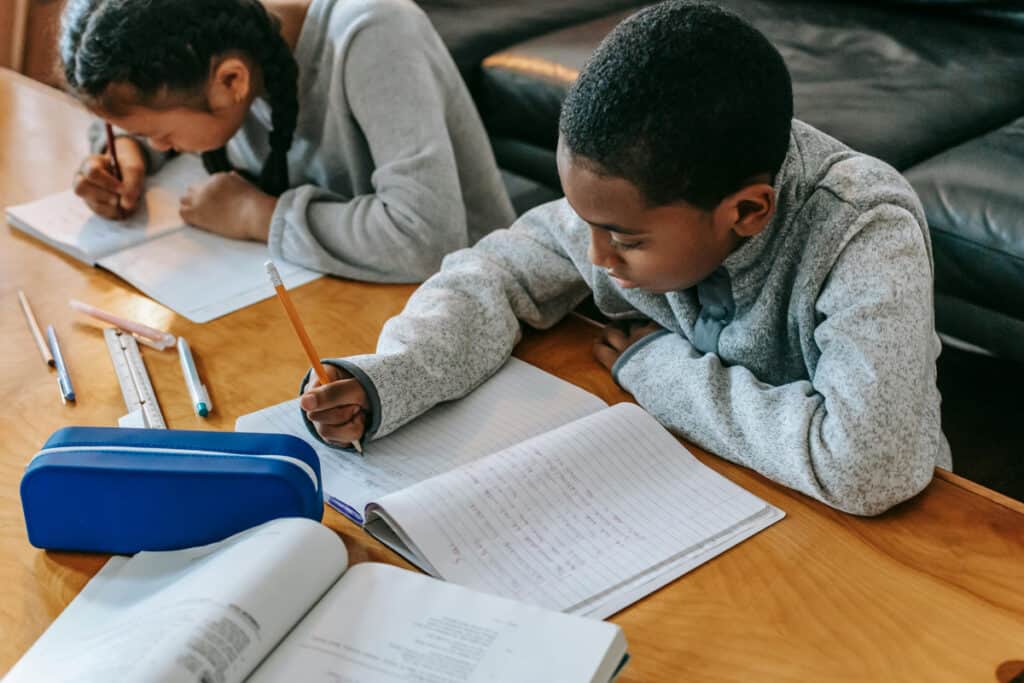
How much summer learning is necessary for children? And how to achieve the Goldilocks amount to keep your child from suffering the Summer Slide.
School has been out for about a month and many parents may be looking for easy-to-prepare academic activities the kids can do to help offset the dreaded “summer slide.” The trick of course is finding activities that have genuine educational value that your child will actually want to do. That’s where Engage the Brain comes in. We have scoured the Internet and curated the best reading, writing, and math activities that your child will enjoy.
Why summer learning is important
Summer is a bridge between school years. Make it a scenic and enjoyable crossing by selecting high value and high interest activities that your child will take to. By engaging in appropriate learning activities, your child will stave off the summer slide, which is the regression of skills during the summer months. Read more about it here.
The questions often raised are: how much learning must my child do to maintain his skills? Is it possible to actually make progress and get ahead during the summer? If so, how?
How much summer learning is necessary?
Most families are looking for the Goldilocks effect: just the right amount of learning to keep skills sharp but not overwork the child so that they become recalcitrant, rebellious, or burnt out.
So how much is the right amount?
Governor’s Early Literacy Foundation reports that children need to read six books during the summer to maintain or improve their reading skills. This could be broken down into daily reading sessions of 20 to 30 minutes, with a mixture of nonfiction, fiction, and online media.
Kids may like reading more than you would think. Nearly 60 percent of children ages 6 to 17 say they love or like reading books for fun a lot, and 52 percent think it’s extremely or very important, according to the Scholastic Kids and Family Reading Report.
According to Dr. Rick N. Bolling, a superintendent at Bath County, Public Schools in Virginia, “One thing is certain: lengthy workbook/skill practices are not innovative and do little to prevent the summer slide. Instead, learning should be viewed as a continuous journey. Just like in athletics, skills need continual practice to become highly successful.” He goes on to say that sessions ought to be short so as not to overwhelm and lose student interest.
Of course a great way to soak in summer learning is by enrolling your child in a summer camp that combines academics and fun. One such program is Summer Smarts, hosted by expert Learning Specialists.
However, if you are looking for less formal options, that’s where our curated list comes in! The activities are broken down into reading, math, and writing activities. They truly are a la carte, so bring them to your child and allow them to pick and choose which one(s) look like fun.
Reading activities
Create a cozy reading nook in your home. Sometimes all it takes to get kids reading is a little imagination. Whether in the living room or in a bedroom, create a cozy reading area adorned with comfy pillows and blankets. Of course it needs enough light to see the pages!
Form a family book club. Have everyone in the family, including parents, join in to read an agreed upon book. Does your family prefer fiction or nonfiction? Set up weekly discussions to share insights about the book, and come up with a catchy name for your family book discussions.
Join a summer reading challenge. Most public libraries offer some version of a challenge for children during the summer months. Often times prizes are awarded for achieving a certain amount of pages read. This could be the motivator your child needs!
Make regular trips to the library. By creating a routine where you go to the library each week kids have the motivation to read and select new books each week. And it is free! As bonus: they can check up on the Reading Challenge they joined!
Incentivize reading. Of course we want children to develop intrinsic motivation, but if your child is a reluctant reader, then offer to bribe, we mean pay them. Set up a reasonable payment plan for each book read.
Get hands-on with science experiments. Encourage your child to read a science book and then conduct an experiment. A good suggestion is The Everything Kids’ Science Experiment Book by Tom Robinson, which uses simple, everyday items typically found around the house. Some are messy but not dangerous!
Math activities
Go on a shape scavenger hunt. As you walk your neighborhood, perhaps with your pet pooch, challenge your child to see how many different shapes they can find. For example, a Stop sign is an octagon and a Yield sign is a triangle.
Hold a Measurement Olympics. Head out to your backyard, if big enough, or to a nearby park. Encourage your child to throw either a baseball or a football and then figure out how to measure how far the ball traveled. Repeat this but this time kick the ball. Maybe bring a tape measure or a ruler or yardstick. Determining how to measure the distance is part of the learning process. Using a stop watch – most smartphones have one in the clock app – time your child running certain distances. This can introduce a discussion about decimals.
Estimation challenges. If your family is headed somewhere on vacation, ask your child to estimate the mileage. Are you driving or flying? Challenge them to make their best estimate in how long it will take to get to your destination. Even just a mundane trip to the market can become a family estimation challenge. Who can come closest to estimating the total cost of the grocery bill? Encourage your child to round prices to the nearest dollar to help make their predictions.
Hopscotch Math. The traditional game of hopscotch lends itself to different math activities. After you draw the basic outline for the game, decide what skill you would like your child to work on. For example, in each box you could place a multiplication fact that your child must solve when they land in that box. Another option is to record fractions in each box, and when your child lands in a section they must announce an equivalent fraction. And yet another option is to place a decimal in each section and when your child lands in a box they must either read the decimal or offer an equivalent fraction. The math possibilities are endless!
Play board games. Board games are a wonderful way to sneak in some math practice. Any game that involves rolling dice and or keeping score naturally involves math. In some games the math is more overt, such as Monopoly, while in other games such as Qwirkle the math is “hidden” within the fun of the game. As a bonus your child can also fine tune their Executive Functions skills while playing games by thinking about strategy and planning out the best way to win the game.
Get cooking. Cooking has so many great math skills. Everything from fractions in the recipe to temperature of the oven to elapsed time to cook the item, not to mention reading comprehension. Because stoves and ovens can be dangerous for younger children, a parent will need to assist in the kitchen. So pick a family favorite food, plan out the ingredients, and start cooking!
Writing activities
Practicing writing during the summer has multiple benefits, including reinforcing skills such as grammar, spelling, vocabulary, and sentence structure.
Send a Pen Pal Letter. A great way to get kids to write is to set up a Pen Pal. Perhaps a grandparent living in another state – or even across town – could be summoned to write back. Whether you choose “new school” and send an email, or “old school” and send a handwritten letter, either way your child is drafting and forming sentences and cohesive thoughts.
Write an original play script. Kids are creative. Some love to play with Lego figures and other childhood staples, while other children like to make their own characters, such as sock puppets. Either way, encourage them to develop a story script and to write it down. Maybe use an existing story for inspiration then put their own spin on the plot. Like the pen pal activity, scripts can be handwritten or placed into the electronic world on a Google doc. Either way is a win for writing!
Make an original greeting card. Perhaps you have a future Hallmark card writer, waiting to creatively express a common sentiment. With some simple supplies like card stock in assorted colors and markers and or crayons, challenge your child to create their own greeting card with appropriate message. Birthdays, anniversaries, graduations, all deserve recognition.
Create their own Mad Lib. Mad libs are those fun short stories that having missing words that a person supplies, based on requests like a plural noun or a verb in ing form that ultimately turn out funny. Kids will love writing these and as a bonus will be reviewing the parts of speech.
Write a new ending to a favorite story. Sometimes, kids just need a nudge to write. After reading or re-reading a favorite story, challenge your child to come up with a different ending to the story.
Respond to a writing prompt. Prodigy has some great writing prompts that your child can choose to respond to. What’s even better is the prompts are divided by elementary, middle, and high school level and by type: creative, persuasive, etc. Challenge your child to respond to one each day.
Final thoughts
Summer and learning do not need to be a binary option for kids: either all fun or all learning. By selecting entertaining and sneaky educational activities, your chid can have the best of both options. Striving for the Goldilocks amount of learning, which ought to include reading, writing, and math activities, during the summer will keep your child’s brain active and the Summer Slide away.
If you struggle to find educational activities for your child or they simply do not want to engage in learning during the summer, contact Jennifer Disch at Engage the Brain to discover how a Learning Specialist could motivate your child by presenting quality, research-backed materials that are both fun and educational.