

How do you set your child up for success at the beginning of the school year? By focusing on your child’s Executive Functions.
Back to school.
This three-word phrase can conjure up different emotions for different populations of people. For students, it could be a mixture of excitement, apprehension, and guarded optimism. For parents, it may be like this commercial, featuring a dad frolicking through Staples to the holiday classic “It’s the Most Wonderful Time of Year,” tossing school supplies into a shopping cart while his two children follow and scowl.
Whatever your thoughts and emotions about back to school are, one thing parents can do now is prepare their children to start the school year with a focus on their Executive Functions. We have written about Executive Functions before, but this article will focus on preparing your child to start the school year off in an organized, thoughtful, and intentional way.
In the article Executive function in children: Why it matters and how to help from Harvard Health Publishing, it says executive functions “supervise and coordinate a multitude of cognitive, behavioral, and emotional tasks.” The article goes on to say that although our executive function skills begin to develop in the first year of life, they are not fully developed until early adulthood. And, executive functioning skills do not develop in a linear progression.
What exactly are Executive Functions?
There are several good analogies for Executive Functions. One is as the conductor of a full city orchestra, manipulating each section of musicians to elicit a coordinated, sometimes nuanced, and beautiful result. Another comparison is that of an air traffic controller, who helps a multitude of planes of various sizes take off and land safely. Whichever analogy you prefer, one can see the complexity and interlocking elements that make up the skill set.
According to the Center on the Developing Child, the major components of executive functions include:
Working memory: which governs our ability to retain and work with pieces of information over short periods of time.
Mental flexibility: which helps us sustain or shift our focus in response to different demands or to apply different rules in different settings.
Self-control: which allows us to set priorities and resist impulsive actions or responses to stimuli.
Focus on the whole child
One aspect of Executive Functions that perhaps does not get enough attention is that the whole child is involved in successfully navigating school and life. Marydee Sklar, who is fabulous and operates the company Executive Functions Success, focuses on three key foundations at the beginning of her Seeing My Time course: nutrition, exercise, and sleep.
Clearly your child must be healthy in order to thrive in school and extracurricular activities. Ensure your child is eating well, getting the proper exercise, and the prescribed amount of sleep. If these three cornerstones are in place, then your child will be ready to accept coaching and guidance in Executive Functions.
Strategies to promote Executive Functions success
Once your child – with your guidance and encouragement – has a handle on their nutrition, exercise, and sleep, try the following six strategies to organize, plan, and establish routines.
Create a “Landing Pad” at home for backpacks, jackets, etc.
Somewhere in your home create a landing pad, where your child can drop off school items such as their backpack, sports equipment, and or jackets. Perhaps the location is inside the front door or in a mudroom. The point is to have one location for all the belongings so everyone knows where the items are.
Establish routines
If your child attends a traditional brick and mortar school, then the two blocks of time to schedule are before school and after school. Establish a routine for before school by communicating what must be done. Tasks may include showering, eating breakfast, packing a lunch (or having lunch money), ensuring all school materials and homework are in the backpack, and/or laptop charged. Creating a routine for after school may include completing homework, practicing a musical instrument, having a snack, attending a sports practice or game, completing chores, free time, and eating dinner.
Routines ease anxiety because your child knows what to expect. Obviously you will need to tailor the items for your child.
Use checklists
Going along with establishing routines, creating and printing checklists and placing them in high-traffic locations, will be visual reminders for your child of what is expected of them. Understood has some examples that you can print. If your child has a locker at school, a separate checklist can be created and taped in it so your child remembers to bring everything she needs home. Or, if there is no locker, a checklist can be attached inside their backpack.
Use a planner
For some reason students seem to balk at using a planner. And ironically it is the students who need the planner the most who protest the loudest! From the first day of school, encourage your child to use some version of daily planner. It may be a physical paper planner that some schools supply. Or, it could be using a digital planner such as the “notes” or “reminders” that most smartphones have. Students should include all of their activities in the planner: homework, upcoming tests or projects, sports practices, play rehearsals, doctor’s appointments, etc. All of their responsibilities ought to be in one place!
Use clocks to make time visual
A refrain heard often during the school year from children is that they do not have any time for themselves. They complain the day is taken up with school, homework, and chores. Perhaps there is a “I hate you!” sprinkled in there too.They gripe there is no time for friends, tv, or video games, the trifecta of the traumatized teenager.
A parent can help their child visualize their time and assist them in seeing that if they manage their allotted time correctly, there is time every day for the fun stuff too! Placing an analog clock (one with a face and hands) in the study area is one way for children to see time tick by. (Another option is to use a kitchen timer.) Encourage your child to estimate how long an assignment ought to take. Then refer to the clock, do some quick mental math, and calculate when the assignment ought to be completed by. This can be an eye-opening exercise for students who tend to waste time while allegedly studying.
Model the behaviors
In a study in the journal Early Child Development and Care, it was found that students who successfully developed Executive Functions skills had a positive family environment along with parents who practiced and modeled the skills. So use a planner and explain how it helps organize and prioritize your day. Keep your belongings organized – the kitchen island is not a good “Landing Pad!” Share your checklists that you may use at work to accomplish your goals. Allow your child to see these skills in action in the real world.
Final thoughts
Back to school can be an exciting and stressful time of the year for students. To help put your child in the best position to succeed, and relieve some of the anxiety, parents can focus on their child’s Executive Functions. Establish routines, employ checklists, and insist that your child use a planner. You can reenforce their importance by modeling these strategies in your own life! Encouraging these skills from the first day of school will allow your child to be proactive and thrive throughout the year.
If you feel like your child struggles with Executive Functions, contact Jennifer Disch at Engage the Brain to learn how a Learning Specialist could help your child develop these critical skills.

How do you build resilience in children? By communicating and allowing your child to practice falling down in safe, low-risk environments.
Life is hard. And people can debate whether growing up today is more challenging than it was 20, 30 or even 40 years ago. One aspect of childhood that will never change is the presence of adversity and stress. As parents, we want to protect our kids and envelope them in bubble wrap every time they leave the house. This may safeguard them against physical dangers, but what about those invisible stressors such as studying for tests or trying out for a team or a school play?
Wouldn’t it be nice if there was a version of bubble wrap that could protect your kids from all types of trauma and stress? Surprisingly, there is!
And it is called resilience.
What is resilience?
According to the American Psychological Association, “Building resilience—the ability to adapt well to adversity, trauma, tragedy, threats, or even significant sources of stress—can help our children manage stress and feelings of anxiety and uncertainty.”
Of course childhood is littered with stressors of all different sizes and magnitudes. And each child’s view of a given situation is different. Confronted with the same problem, one child may see a speed bump while another child glares up at Mt. Everest.
What accounts for these point-of-view differences? Certainly a child’s DNA can contribute, but perhaps more importantly the answer lies in the child’s parents providing opportunities for the child to practice problem solving in safe environments.
Why build resilience?
Building resilience is like providing your child with superhero powers. Anxiety, setbacks, and trauma can be framed appropriately and dealt with in a rational method.
Just as importantly, building resilience in children helps them to overcome obstacles more easily and reduces the chances of their suffering from anxiety or other stress-related disorders later in life.
What parent does not want that?!
How to build resilience
The Center on the Developing Child at Harvard University says, “The single most common factor for children who develop resilience is at least one stable and committed relationship with a supportive parent, caregiver, or other adult.”
Among other factors that contribute to developing resiliency are:
- facilitating supportive adult-child relationships
- building a sense of self-efficacy and perceived control
- providing opportunities to strengthen adaptive skills and self-regulatory capacities
To expand on building this critical life-skill in children, Engage the Brain contacted Dr. John Avritt, Robin Coach, and Master Resiliency Trainer and Performance Expert who works with soldiers at Fort Hood in Texas.
Dr. Avritt’s first piece of advice revolves around dinner time. He encourages everyone to put away their phones and devices, and for parents to pose three questions to their kids.
First, what is something everyone did today that made them proud?
Second, what is something everyone appreciates about today?
And third, what is something everyone is looking forward to tomorrow or in the near future?
Dr. Avritt said, “This will help everyone begin to notice the good things in the moment, daily, plus it will help everyone in the house turn off their stress switches before bed, which will promote better sleep.” And he added that it will help with family communication.
In addition to discussing these three questions, Dr. Avritt encourages families to take advantage of “confetti,” what he refers to as unexpected free time during the day. Because we as a society are more efficient than we have ever been – some studies suggest we worked 10% more 20 years ago – we are gifted pockets of time which can come in the form of as little as 10 or 15 extra minutes or sometimes even a whole day. Dr. Avritt says to NOT fill that time with more work! He suggests using the time to enhance your relationship with your child, which reinforces Harvard’s finding as the single most important part of developing resiliency in children.
Other ways to develop resilience
Dr. Avritt reports there are five core competencies that all people need to practice to develop resilience.
1. Building self-awareness
We all have thoughts and reactions to life’s events. Do we have the ability to capture those thoughts, identify what emotions and reactions are being driven by those thoughts, and ask the question, “Are my thoughts helping me or harming me?”
2. Regulation of thoughts
Dr. Avritt says, “If we want to dictate certain emotions, it begins by taking the thoughts we’ve captured and reframing, reinterpreting, or repurposing them for our benefit.” Parents can help with this by constructive conversation and not hijacking a dialogue. There is a common contradiction: parents want their child to problem solve, but when the child fails, the parent is quick to jump in and fix the situation. This can send mixed messages to the child.
3. Connection
Nobody is expected to travel through life alone. Help your child understand the power of relationships and both how to be a helper and how to get help. Model how to be a good listener and how to ask questions. This helps build empathy, compassion, listening skills, and connection to others.
4. Internal strengths
Teach your child to learn and develop an understanding of who they are. It is important that children use their strengths to their advantage and not dwell on who they are not. Parents can help point out their child’s inner strengths and provide concrete examples to back up their point of view.
5. Optimism
We all need to practice recognizing the good that happens to us on a daily basis. Dr. Avritt says that this will counteract human nature’s negativity bias. By engaging in a daily dinnertime conversation and using the three guiding questions listed above, parents can chip away at their child’s potential negative viewpoints and replace them with more resilient thoughts.
Finally, Dr. Avritt implores parents to not be afraid to let their child fall down or fail. “Dictating to our kids how and when to perform is a parent problem, a result of protecting our own egos,” says Dr. Avritt. To be resilient, kids need to experience adversity so they can figure out how to get back up. And if they can’t get back up, then parents can join in and help the child determine the best way to solve the given situation.
Final thoughts
Our lives are littered with stress and anxiety- which come in all shapes and sizes- pretty much on a daily basis. Helping your child build resilience and develop a toolbox full of strategies to help confront these situations is paramount for parents. The research is clear: a supportive parent who provides opportunities to practice problem-solving in low stakes situations helps a child develop this critical skill. Using daily conversations that focus on promoting self-awareness and optimism are essential for your child’s future success.
If you believe your child struggles with stress, anxiety and how to appropriately respond to stressful situations, please contact Jennifer Disch at Engage the Brain to discover how a Learning Specialist could assist your child in developing strategies to build their resilience.

What is social emotional learning? And how can parents use it to help reset their child’s mental health?
Last month we wrote about the importance of resetting your child’s summer schedule and goals with a clarion call to prioritize their mental health. Children – all of us, actually – have been through tremendous stressors and uncertainties over the past two years. But in reality there has been a mental health crisis building in children over the past decade or more.
The reasons are varied. Increased social media consumption and comparing themselves in their very realistic and messy 3-D life to a carefully crafted digital 2-D presentation of classmates on Instagram can be confusing for youngsters. Clearly isolation and lack of social connection during the pandemic have contributed. And the stressors of family illness and/or job security are playing a part.
The statistics back this up. From March 2020 to October 2020, mental health–related emergency department visits increased 24% for children ages 5 to 11 and 31% for those ages 12 to 17, compared with 2019 emergency department visits, according to CDC data. These visits were for varied reasons- including eating disorders, anxiety, trauma, and obsessive-compulsive disorders.
But as mentioned above, these issues had been percolating below the surface in children for years. In an article in The New York Times, John T. Walkup, chairman of the psychiatry and behavioral-health department at Lurie Children’s Hospital of Chicago, said, “The biggest misconception is that Covid makes people mentally ill. From my point of view, Covid unmasked people who have underlying vulnerabilities.” Indeed, those people who had been hanging on by a thread felt that razor thin margin of error falter as the reality of the pandemic hit.
Social Emotional Learning (SEL)
What is the antidote? Enter social emotional learning.
What is social emotional learning? The Collaborative for Academic, Social, and Emotional Learning (CASEL) defines it like this: “SEL is the process through which all young people and adults acquire and apply the knowledge, skills, and attitudes to develop healthy identities, manage emotions and achieve personal and collective goals, feel and show empathy for others, establish and maintain supportive relationships, and make responsible and caring decisions.”
At the heart of SEL, CASEL has identified five competencies that support learning and development of children:
• self-awareness: child understands his or her own strengths and weaknesses and how their behavior affects others.
• self-management: child learns how to regulate their behaviors and emotions.
• social awareness: child understands social norms, can recognize other people’s emotions, and empathize with people from a variety of backgrounds.
• relationship skills: child can foster healthy relations with individuals and in groups.
• making responsible decisions: child learns how to make decisions independently, whether it is a school-based decision or personal matter, while considering social norms and all appropriate consequences – both positive and negative – of the decision.
CASEL’s research has indicated positive academic gains and better emotional health when SEL is part of the curriculum. In particular:
• SEL interventions that address the five core competencies increased students’ academic performance by 11 percentile points, compared to students who did not participate.
• Students participating in SEL programs showed improved classroom behavior, an increased ability to manage stress and depression, and better attitudes about themselves, others, and school.
A study in the journal Perspectives on Psychological Science called “Promoting the Social and Emotional Learning of Millions of School Children,” produced the following findings: “Through explicit instruction, social and emotional skills can be taught, modeled, and practiced so that children, adolescents, and adults can handle daily tasks, interactions, and challenges effectively.” These critical skills can be broached and taught at home! Maybe parents and caregivers can even learn something too!
Warning signs your child may be struggling
While every child may have mood swings from time to time – hello teenagers! – there are signs parents can look for that may signal that a larger issue is lurking. According to the National Library of Medicine, parents can look for these:
Physical signs:
• decreased appetite, and or change in eating habits
• Sleep disturbances
• Physical symptoms: headache, stomachache with no illness
Emotional or behavioral signs:
• Anxiety, worry
• New or recurring fears
• Anger outbursts and or crying
• Aggressive or stubborn behavior
• Doesn’t want to participate in school or family activities
If your child is exhibiting any of these warning signs, please contact your child’s pediatrician. If you are interested in locating a mental health professional, the Department of Health and Human Services or SAMHSA has a website.
Teaching SEL at home
Hopefully you are convinced of the importance of teaching and nurturing SEL skills. Not only will they improve your child’s academic performance, they will help build resiliency and problem-solving skills critical to their success as adults.
So how do you teach these critically important skills at home? Thoughtfully and intentionally. In other words, target one of the five competencies listed above, and try some of the activities presented below to help your child nurture their SEL skills.
Self-awareness:
To foster self-awareness in your child, help them identify their emotions and feelings. Guide them to react to their emotions properly by taking deep breaths or engaging in a physical activity such as taking a walk. Further, help your child identify their strengths and weaknesses so that compliments and criticisms can be framed appropriately.
Self-management:
Building self-management can be fun when using games. Games like Jenga require focus and precision to succeed in removing pieces from the tower. Another great game is Don’t Break the Ice, which also requires a steady hand and an element of tempered force. Even the traditional game Simon Says can help children learn to manage their movements and thoughts based on the leader’s commands.
Social awareness:
After having a conversation with another person or even another family member, discuss it with your child. Focus on each person’s body language and tone, which contributes to the civility – or lack there of – in the conversation. Remember to discuss non-verbal cues, which will allow your child the opportunity to learn how these can make other people feel. Perhaps most importantly is to be a good role model for your child. Most kids are like sponges, soaking up how you treat and interact with other people.
Relationship skills:
Forming, developing, and maintaining relationships is critical for your child to succeed in life. Pick a good friend of your child’s and ask your child why his friend is special. Perhaps the friend is supportive or kind or shares common interests. Emphasize the importance of reciprocating those skills with his friends. Just as important point out any unhealthy relationships your child may have. Discuss what the supposed friend does that is “toxic” and share conflict resolution strategies.
Making responsible decisions:
Neuropsychologists allege we make over 35,000 decisions a day. While some are small – which shirt to wear – others are huge – should I cross the street now or wait for the truck to pass – learning how to make responsible decisions is critical for your child’s development. Luckily there is a formula or series of steps you can teach: Identify the problem to be solved; gather relevant information; brainstorm possible solutions; identify possible consequences; make a choice; take action. Model these steps with problems you face so your child can see them in action in real life.
Final thoughts
Parents can use SEL at home to help their child become better equipped to deal with the world in which they live. And their academics will improve too! By acknowledging there is a mental health crisis in our country, parents can start a dialogue with their children and simply ask, “How are you doing?” During those conversations teach them the five core competencies that make up SEL. Perhaps not right away, but eventually they will thank you.
If you believe your child could benefit from SEL strategies and would like more detailed information, please contact Jennifer Disch at Engage the Brain.

What is the ideal 2022 summer schedule for a school-aged child? A little learning, a lot of movement, and a heavy dose of play.
It is May and nearing the end of the school year, so most education blogs targeting parents write the obligatory article on the “Summer Slide.” Of course, the Summer Slide, or Summer Brain Drain, is the loss of learning and/or regression of academic skills a child experiences over the summer months.
But this summer – the summer of 2022 – seems like a perfect time for parents to rethink their child’s summer schedule. Perhaps reevaluate what is important for your child to achieve during the summer months. While the threat of learning loss is real, there is a bigger menace out there targeting your child: a mental health crisis.
As the school year comes to a close, may we suggest parents focus on or redefine a new North Star: a relaxed, confident and mentally healthy child. Because the statistics about children and mental health are scary. The National Alliance on Mental Health states that 20% of youth ages 13-18 live with a mental health condition; 11% of youth have a mood disorder; and 8% of youth have an anxiety disorder. The statistics for LBGQT+ children are even more frightening. The COVID-19 pandemic has exacerbated these numbers! Social isolation, job security of parents, and loss of loved ones are a few of the reasons why children’s anxiety and depression have escalated.
How should parents approach this summer? In a word: balance. As the amazing author Robert Fulgham said, “Be aware of wonder. Live a balanced life – learn some and think some and draw and paint and sing and dance and play and work every day some.” This quote is the perfect North Star for this summer of 2022.
Summer Slide stats
Much has been written about the Summer Slide, including which students it affects and how. Most reasonable people can agree that if a child does not read or write something over the summer, their language skills will regress. The same is true in math if no computation or work with numbers occurs either.
In the article “What we know and what we’re learning” by Megan Kuhfeld, the author shares some research from recent studies. The first study, “School’s out: The role of summers in understanding achievement disparities,” was recently published in the American Educational Research Journal and examined summer learning loss across grades 1–8. The study found the average student lost 17-34% of the previous year’s learning gains over summer break; and students who lose ground over one summer are more likely to lose ground in the ensuing summers.
A Southern Methodist University study conducted by Chalie Patarapichayatham, PhD, ambitiously attempted to parse out Summer Slide statistics from COVID-19 Slide statistics. Not surprisingly, he found that students performed lower throughout the 2020-2021 school year, when many schools were employing remote or hybrid learning models. In reading, students experienced a Summer Slide in some grades, but all students experienced a COVID-19 Slide. In math, all students experienced a Summer Slide and COVID-19 Slide. And the study found that students lost their math ability more rapidly than their reading ability, and the loss was larger in upper elementary students.
Create a summer routine with lots of flexibility
So, how do you balance the need for academics to keep your child from experiencing summer learning loss and the clear call for a mental health reset? By creating a routine that has lots of flexibility that includes some learning, some movement and some play.
Incorporate lots of exercise and movement
Children do not seem to be getting the necessary exercise they need for a healthy lifestyle. Each day kids needs to be getting their heart rate up. How do you determine whether your child is actually doing enough? Turn to the CDC.
Exercise intensity levels from the CDC are broken down like this: On a scale of 0 to 10, where sitting is a 0 and the highest level of activity is a 10, moderate-intensity activity is a 5 or 6. When children do moderate-intensity activity, their heart beats faster, and they breathe much harder than when they are at rest or sitting. Vigorous-intensity activity is a level 7 or 8.
Harvard School of Health – and who doesn’t trust an Ivy League institution – says that children need 60 minutes of moderate to vigorous exercise every day, though it does not need to be done all at once. It could be 10 minutes bursts with vigorous level exercise at least 3 days a week.
If your child plays a sport, chances are they are meeting the movement requirement. However, if your chid does not play on a team, you need to find ways to get them moving. This article from Nemours Children’s Health has some wonderful tips to get your child active.
Sprinkle in some learning
As mentioned above, the Summer Slide is real and children will lose ground over the summer if they do not engage in some form of learning. And while our focus is on resetting your child’s mental health, they still need to keep their skills active; falling behind academically can be very stressful for students. Some research suggests that reading as few as four books over the summer is enough to stave off learning loss. And, as referenced above, math takes a hit too. Math workbooks – while well-intentioned – do not fight off the Summer Slide. Children need higher level challenges with numbers. Great Schools has some activities to keep the kids counting over the summer.
Don’t forget the play
Too often children are over-scheduled during the school year. In addition to meeting the demands of being a successful student, some children balance a multitude of after-school activities. So while you are acting as a coach and blowing your whistle to get your kid moving, and playing teacher and demanding your child read, do not forget good old-fashioned play.
Believe it or not, it is okay for your child to be bored! Because out of that boredom can emerge creativity. Also, it will place your child in the present, where they can focus on the here and now. The word “mindfulness” has gotten a lot of attention recently and for good reason: by allowing your child to sit with their thoughts, they can truly focus on their environment and find things to do.
In addition to fostering an environment where your child must create their own play, there are many fantastic and easy activities that you can turn to when needed. Edutopia has a great list of activities to help foster play in your child.
Final thoughts
Children are stressed and are literally facing a mental health crisis. This summer is the perfect opportunity to reset your child’s whole world view. Yes, academics are important and the Summer Brain Drain is real, but if your child is stressed, depressed, anxious, or all of the above, then academics are not the top priority. While happy is an elusive and perhaps misplaced goal, mentally healthy should be the focus for your child for this summer.
To reach this goal, one can think of it another way. Most dietitians recommend a combination of 45-65% carbohydrates, 10-35% protein and 20-35% fat. But rather than food percentages, break a summer day into 10-35% summer learning; 20-35% exercise and movement; and 45-65% play or whatever lights up your child’s heart.
If you would like to discuss ways to create a balanced summer schedule for your child, please contact Jennifer Disch at Engage the Brain.

As the school year draws to a close, here is the ultimate list of advice, tips, and tasks for parents to complete.
It is mid-April and in Florida the end of the school year is rapidly approaching. As a parent, you may have a mix of emotions as you watch your child complete an orbit through another school year. Like a ferris wheel rotating, with its speed ebbing and flowing as seasons come and go, the end of the school year seems to accelerate to a crescendoing end.
Depending on their grade, your child may just be starting their school journey, and you have many years of milestones and celebrations ahead. Or, perhaps you have a high school student, who, like a magnet, has been more attracted to their friends and social obligations than you and your home.
Whichever end of the spectrum you are on – or perhaps you are traversing the turbulent middle school years, which places you literally in the middle – the end of the school year requires a parent’s attention to detail to help your child finish the school year strongly.
And wouldn’t it be nice if there were a master list of tasks to complete? Like someone scoured the internet and curated the best tips and tasks for parents to complete before the end of the school year.
You are in luck because Engage the Brain did just that! What follows is a comprehensive list of advice, tasks, and tips for parents to complete as their child’s school year comes to a close.
Tasks to complete
Add end of school year events to calendar
The end of the school year may bring school concerts, play performances, graduations, and or other special events. Be sure to add them to your family calendar (you have one these, right?) to avoid conflicts with other obligations.
Maintain a schedule
Encourage and perhaps even demand that your child maintain a schedule. Enforce bedtimes, homework times, and meal times to ease the hectic nature of the last month of school.
Motivate/reward (bribe) to end school year strong
Spring fever can hit kids hard, and motivation and interest in school can wane quickly. While internal motivation is always best to cultivate, combatting and treating spring fever may require some external encouragement. Whatever motivates your child, perhaps this is the time of year to offer up incentives to ensure your child finishes exams, projects, and papers with the proper attention and effort.
Return all school property
Begin gathering all the items that need to be returned to school. Library books (do those still exist?), athletic equipment, text books, etc. all typically need to be returned to avoid a fine or replacement cost.
Review community service hours for teens (if required)
If your child is in high school, they may have a service hour requirement. These can be required for scholarships and graduation, so ensure your child is making the appropriate progress towards the service goal.
Review child’s accommodations (IEP/504)
If your child has an IEP or 504 plan, typically the school will hold a meeting to review the accommodations listed. Discuss these with your child. Is the school providing the accommodations? Are they working? Should you add one or change one? Be prepared for the meeting or request a meeting if necessary.
Apply/extend any financial aid or scholarships for next year
Make sure you complete any paperwork or visit any websites required to apply for or extend any financial aid or scholarships (Family Empowerment Scholarship, McKay, Gardiner for example) your child receives. Most have firm deadlines, so review the requirements and act now.
Firm up plans for next school year
Is your child returning to the same school? If so, you are all set. If not, ensure all details all taken care of for the new school so your child can seamlessly matriculate into the next school year.
Ease anxiety (about next school year if child is making a jump from elementary to middle or middle to high school)
Going along with the previous pearl of wisdom, if your child is switching to a new school, make plans to visit the new one either at the end of the current school year (if possible) or even during the summer. Perhaps chatting with siblings or friends with siblings who attend the school can ease jitters and concerns.
Thank you’s and or gifts for impactful people: teachers, coaches, …
As the year winds down, plan which impactful people at your child’s school – or other locations – you would like to formally thank. Purchase thank you cards or other tokens of appreciation in advance so you are prepared to acknowledge those important people.
Plan summer learning activities
To avoid the summer slide, plan what enrichment, remediation, and/or therapies your child will need to address this summer. Professionals who work in these fields fill up their respective schedules quickly, so act now to reserve your child’s spot.
Enroll in summer camps
After two summers of uncertainty due to COVID-19, many camps will be open and ready for children. Plan which one(s) your child will attend and reserve your spot(s) because they will fill up.
Plan job opportunities for teens
Summer jobs are great opportunities for teenagers to learn (or practice) responsibility and earn a few spending dollars. Not sure if your child is ready for a “real” job? Family Education has some information for parents to consider.
Celebrate
Finally, don’t forget to celebrate! Successfully navigating another school year ought to be honored. Perhaps dinner at a family favorite restaurant or some other reward to acknowledge your child’s (and your) hard work.
Bonus activity
It would be a wonderful tradition to start by holding an end of year interview with your child. With video capability on most smartphones, recording the conversation would be easy and a fantastic keepsake.
Possible questions to ask your child could include:
What is the most important thing you learned this year?
What is your favorite memory of this school year?
How have you changed this year?
What is something hard you did?
Who was your favorite teacher?
What was the best gossip this year?
Final thoughts
The end of the school year is a hectic and busy time of the year. Like a planet orbiting around the sun, your child is completing another important journey as they finish one more grade. While emotions such as pride and nostalgia (or anger and bewilderment) may bubble up to the surface, remember to complete all the necessary tasks to ensure your child finishes the school year with effort and confidence.
If you have any questions about your child’s end of school year tasks, summer plans, or academic needs, please contact Jennifer Disch at Engage the Brain.

What are the causes of student burnout and what can parents do to help reignite a love of learning?
If you pay attention to the news, and in particular news about K-12 education, you have probably read (or heard) that teachers are leaving the profession in droves; they are burned out. Many educators cite the pandemic as the the proverbial straw that broke their back. Following CDC guidelines, dealing with the controversy of masks, and yo-yoing again and again between at-home and in-school instruction broke many teachers.
Understandably.
But students are hurting too. And, quite simply, they- like their English and Algebra and kindergarten teachers- are burned out, too. For many of the same reasons as their teachers, as well as a whole slew of reasons that are more children-specific.
There is a huge- Mariana Trench deep- difference, though, between teacher and student burnout: teachers are free to leave and pursue other occupations. K-12 students must stay in school and fight through all the demons that so many people are currently battling, while trying to keep their heads above water.
Student Burnout defined
What exactly is student burnout? In the article “Educators and Students Are Burned Out. These Strategies Can Help,” Harvard Business Publishing defines it like this: “it presents as a combination of three symptoms: exhaustion (a depletion of mental or physical resources), cynical detachment (a depletion of social connectedness), and a reduced sense of efficacy(a depletion of belief in oneself).”
Parents, does your child look or sound like any of these three descriptors? Are they exhausted? Do they feel less or no connection to their friends? Do they feel like school is just too hard?
Here is the catch: the pandemic did not provoke or cause these symptoms. Students have been struggling with these critical issues for years. The pandemic only shone a 10,000 watt spotlight on the problem!
What causes student burnout
A study by research.com revealed what teens are concerned about:
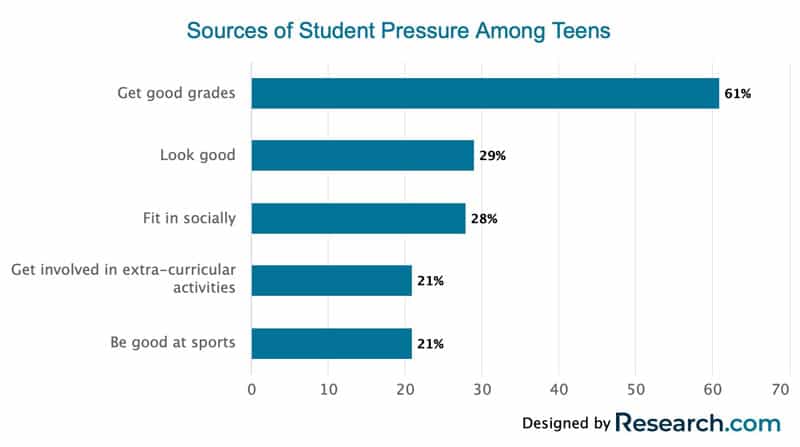
The study also found:
- Seven out of ten teens in the U.S. (between 13 and 17 years old) have named anxiety or depression as a major problem among their peers in the community.
- 75% of U.S. high school students expressed boredom, anger, sadness, fear, or stress while in school.
- On a 10-point scale, where normal values for adults are 3.8, American teens rated their stress rate at an average score of 5.8.
- Three quarters (75%) of American high schoolers and half of middle schoolers described themselves as “often or always feeling stressed” by schoolwork.
Students with learning differences tend to get whacked even harder. The excellent website understood.org lists some reasons as to why. First, they work harder than their peers to achieve a similar result. Next, their schedules tend be busier than their peers due to getting additional help or therapies. Finally, they may struggle with attention and just take longer to complete an assignment.
Denise Pope, a senior lecturer at the Stanford Graduate School of Education, found that in addition to grades, course work, and time management, students were particularly stressed about lack of sleep. Pope thought that remote leaning would provide opportunities for students to catch up on sleep, but her research found that 43 percent of the students reported sleeping less, and about 5 percent said they were getting less than four hours a night. Overall, kids reported being more stressed than before the pandemic began!
Strategies to combat student burnout
As documented above, student burnout tends to come from exhaustion, a lack of social connections, and/or a loss of one’s belief that they can succeed. A good first step for parents is to decode which symptom or symptoms their child is suffering from. From there, try the following strategies to combat student burnout.
Practice self care
We wrote extensively about the importance of self-care for children here. Start by creating a routine in the morning before school and a routine for after school, which will develop predictability and ease anxiety. Mix in some exercise to get the heart rate up and focus on establishing a sleep schedule.
Create healthy habits
Creating healthy habits can begin with monitoring your child’s diet. Recently we wrote about the importance of a balanced diet and its contribution to academic performance. At least in your home, you control the supply line of food, so ensure there is an abundance of healthy choices available. Additionally, encourage/demand a prescribed sleep schedule. Teenagers ought to be getting about 10 hours of a sleep a night. And as mentioned above, moderate to vigorous exercise will pay dividends with mental health.
Play games
If your child is suffering from burnout, there is more than likely an absence of fun in their lives. A great way to combat the feeling is from playing! Play can take many forms, from good old- fashioned board games like Monopoly and Sorry to card games like Uno. Psychology researcher Peter Gray argues that as opportunities for play decrease in children, it contributes to a rise in anxiety and depression. He argues that anxiety and depression strongly correlate with peoples’ sense of control – or lack of control. Researchers have studied play and arrived at a fascinating conclusion: the opposite of play is not work, it is depression.
Practice mindfulness
The website mindful.org defines mindfulness as the basic human ability to be fully present, aware of where we are and what we’re doing, and not overly reactive or overwhelmed by what’s going on around us. This has become increasingly difficult in our perpetually digitally connected lives. Encourage your child to disconnect! Benefits of mindfulness include improvement in emotional regulation, memory, and cognitive function; better grades; increased focus; improvement in both relationships and physical health; and reduced levels of anxiety and stress. Check out this article for simple suggestions to practice mindfulness.
Stay connected to their social network
Children are wired- all humans are wired- to want to connect. The pandemic has put a huge crick in people’s ability to meet in-person. While everyone’s social networks have been disrupted over the past two years, children especially have been hit hard. If your child has struggled with maintaining their friendships due to the pandemic, or some other reason altogether, encourage them to reconnect, and model this in your own life, as well. Remind your child about how to have conversations, how to take turns, and about the importance of listening.
A final word
After two years of a pandemic that disrupted all of our lives in unimaginable ways, people are burning out. Children can and do burnout too! Typically a parent will see extreme and prolonged exhaustion, a socially isolated child, and declaration that school is simply too hard. It is also important to acknowledge that children have been struggling since way before the pandemic arrived; it just blasted a Halogen bulb on the issue. By practicing self-care, developing healthy habits, incorporating some game time and play, and reconnecting to their social networks, children can beat burnout.
If you suspect your child is suffering from burnout, please contact Jennifer Disch at Engage the Brain to discuss ways a Learning Coach may be able to assist you child to reignite their love of school and learning.

Monitoring your child’s vascular health is important. Here are five ways to keep their heart healthy.
February is American Heart Month, a time to focus on cardiovascular health. And contrary to the latest edition of your favorite podcast, there are no secrets or “hacks” when it comes to heart health. Two words most people think of as four-letter words – diet and exercise – are still the two best tools to promote your vascular health.
But what about children? How is their heart health? Just because someone is young does not mean they have a healthy heart. There are some shocking statistics that ought to sound alarm bells.
The pandemic ushered in remote learning, and screen time skyrocketed. Even before the pandemic arrived, screen time has been increasing over the past 50 years. Detriments of screen time include a decrease in both focus and emotional regulation.
According to the National Health Council, 40% of the United States population has at least one chronic disease. Up to 50% have two! High blood pressure is the number one chronic disease in the world. An alarming 70% of the U.S. population is overweight or obese, which yields high blood pressure, high cholesterol, and other risks for heart disease.
As we wrote about last month, nutrition plays a significant role in children’s overall health. Our goal this month is not to rehash or feed you word leftovers – though it is worth the read! Rather, the objective is to shed light on a different type of pandemic affecting both adults and children: sedentary lifestyles coupled with poor diets are ravaging our collective heart health.
Information about the heart
The American Heart Association provides a layman’s explanation for how the heart works. First, the heart is a muscle that sits in your chest, tilted slightly to the left. Perhaps the biggest difference between your heart and all the other muscles in your body is that the heart never rests!
The AHA describes the heart like this: “The heart is made up of four rooms or chambers. The two right chambers receive blood from all over the body and pump that blood to the lungs where it picks up oxygen and drops off waste from organs and other cells. Once oxygen-rich blood leaves the lungs, it goes to the chambers on the left side of the heart where it is pumped back out to body.”
It is important to have a basic understanding of how the heart works so that you can comprehend how heart disease may attack the body. Heart disease or cardiovascular disease (CVD) is a health condition that stops the heart or blood vessels from working properly. When the heart is working properly, blood is pumping and circulating around the body freely. If there is a clog in our blood vessels or if our heart is not pumping blood properly, this prevents blood from being delivered to many important parts of our body. Not having blood constantly delivered to the many important parts of our body can cause serious illness or even death. CVD results most often from poor lifestyle choices, such as eating unhealthily or not getting enough exercise.
Keeping your heart healthy
Though genetics do play a role in our health, diet and exercise are two pillars of a healthy lifestyle. While it may appear children do not listen to parental words of wisdom, they most certainly pay close attention to your actions. Modeling a healthy lifestyle goes a long way to encouraging your child to adopt a similar path.
What else can you do to promote a healthy heart in children? Here are some suggestions from Children’s Health:
- Keep moving
Pick activities that the family can do together. Go for a bike ride on a local bike path or take a walk around the neighborhood. The CDC recommends children get 60 minutes of moderate to vigorous exercise every day.
- Limit screen time
As referenced above, children are on computers during school for the most of the day. Too much screen time often is accompanied by munching on unhealthy snacks. Set limits of TV and video games. The American Academy of Pediatrics recommends no more than 60 minutes per day during the week and 2 hours per day on weekends.
- Go to the grocery store together
In addition to feeding the family healthy food choices, bring the kids along to the market. Teach them to read food labels and that a proper diet includes whole grains, low fat dairy products, fish, poultry, and nuts. Children’s Hospital of Philadelphia has an excellent summary of nutritional information.
- Drink water
About 60% of our body weight is made up of water, which we require for every single body function. While each person’s needs are slightly different based on things such as age and activity level, WebMD suggests children drink about 6 to 8 cups (48 to 64 ounces) of water a day. Water. Not juice, not Gatorade. Gulping down water helps eliminate waste, regulate body temperature, and protect vital tissues.
- Stay involved
In addition to monitoring your child’s diet while they are in your home, ensure they continue to eat a healthy diet at school. Your child will trade their kale chips for their friend’s sea salt and vinegar chips – in fairness, who wouldn’t?! So, communicate with your child about the importance of adhering to the food you send them into school with. Additionally, consult with the pediatrician to make sure they are monitoring cardiovascular indicators such as BMI, blood pressure, and cholesterol.
Final thoughts
Hearts tend to pop up all over the place in February: candy hearts, heart shaped pendants, and heart decorations in stores and businesses all promoting love in its various and beautiful forms. As you are celebrating the ones you love, don’t forget the most important hearts of all: those beating in your loved ones’ chests. Being intentional with your food choices and keeping active are two ways to promote a healthy ticker in each family member.
Engage the Brain encourages all of our families to eat healthily and adopt an active lifestyle.

It is January, and talk of New Year’s resolutions typically swirls in conversations. Topping people’s lists often are getting healthier and saving more money during the new year. Parents with school-age children may possess slightly different resolutions. For themselves, it may be a week night without a meltdown about the idiocy of learning their times tables from one of their children. Or that when they open the dishwasher it is actually empty. Small but powerful resolutions to keep their marriage and sanity running smoothly.
As parents are driving to and fro in their minivans, reflecting on the past year and deciding among a few resolutions, may we suggest a powerful one to incorporate for their children? To be intentional as to what food their children are putting into their bodies.
There is so much research about the connection between proper nutrition and learning, and it is compelling! Though we are not necessarily focusing on weight for the purpose of this article, eating healthily and maintaining a healthy weight are generally directly related. According to the National Institute of Diabetes and Digestive and Kidney Diseases, 1 in 6 or 17.2% of students are obese. As many as one third more are overweight. Healthline states that 36.5% of adults are obese; another 32.5% are overweight. Meaning that more than two thirds of U.S. adults are overweight or obese.
Rather than hop on a soap box and extoll the damage excess weight does to the body, the goal here is to focus on food and learning. In other words, what your child is eating directly affects how effectively they learn! There are both long and short term effects related to dietary choices and how a child processes and learns information.
Better nutrition equals better students
Though it seems like common sense, the better quality food a child eats, the better they will feel, and the better they will perform in school. Studies show that nutritional status can directly affect mental capacity among school-aged children. According to one study in the Nelson Textbook of Pediatrics, deficiencies in certain vitamins and minerals- specifically thiamine, vitamin E, vitamin B, iodine, and zinc- are shown to inhibit cognitive abilities and mental concentration. A different study demonstrated that showing improvements in nutrient intake can influence the cognitive ability and intelligence levels of school-aged children. And a third study in the journal Preventive Medicine stated a lack of adequate consumption of specific foods- such as fruits, vegetables, or dairy products- is associated with lower grades among students.
Nutrition education is non-existent
Now that we know that a well balanced diet will improve not only your child’s physical well-being, but also their mental acuity, the question becomes how do we encourage them to eat properly?
According to the CDC, students in the U.S. receive less than 8 hours of required nutrition education each school year, far below the 40 to 50 hours that are needed to affect behavior change. So if they are not teaching nutrition education at school, it appears that parents need to step up and add this to their already full list of responsibilities they must impart on their kids. Parents must not only raise children who know their Ps and Qs but also like their peas and carrots!
Need more convincing that nutrition education is a must? Research shows that nutrition education can teach students to recognize how a healthy diet influences emotional well-being and how emotions may influence eating habits.
Nutrition education at home
Now that you are convinced that teaching your children about nutrition is important, how do you do it? Kidshealth has several suggestions:
- Parents control the supply line
In other words, you buy the groceries and you can control what foods and snacks are available in the house.
- Be a role model
Kids watch every move a parent makes. Make sure you make good choices and eat a healthy, balanced diet.
- Drink calories count
Sodas and other sweetened drinks are full of sugar. Encourage milk and especially plain, filtered water.
- Involve kids in food shopping and cooking
In addiction to learning about a balanced diet, children can learn valuable life skills, such as how much money groceries cost and how to prepare a meal.
Foods that boost brain power
While listing all the reasons to eat healthily and all the missing vitamins in many children’s diets seems like a convincing approach to focus more on the foods we offer our children, Harvard Medical School has streamlined the menu and provides an easy to consult list of foods and their respective benefits. The next time you head to the market or have groceries delivered, make sure to include:
- Green, leafy vegetables
Greens such as spinach and broccoli are rich in brain-healthy nutrients like vitamin K, lutein, folate, and beta carotene. An added bonus for parents to adding these veggies to the menu is research shows they can reduce cognitive decline among adults.
- Fatty fish
Fatty fish are loaded with sources of omega-3 fatty acids. Studies suggest eating fatty fish twice a week, but if the kids balk there are some possible substitutes: an omega-3 supplement or flaxseeds, avocados, and walnuts.
- Berries
Flavonoids, the natural plant pigments that give berries their bright colors, also help improve memory, research shows. Again, a bonus for moms: a study found that women who consumed two or more servings of strawberries and blueberries each week delayed memory decline by up to two-and-a-half years.
- Walnuts
Nuts are excellent sources of protein and healthy fats. A 2015 study from UCLA linked higher walnut consumption to improved cognitive test scores.
- A variety of seeds
Pumpkin seeds are high in zinc, which is required for healthy brain function. Reduced zinc status in the brain can lead to developmental issues such as anxiety and depression. Chia seeds are rich in fiber, magnesium, and alpha-linolenic acid (ALA), a type of omega-3 fatty acid,.
- Greek yogurt
A healthy brain needs protein, and Greek yogurt is packed with it. It also contains probiotics, which strengthen the gut. Kids generally like it, and it can be customized to include berries and nuts, making it a win-win superfood.
A final word
So much attention gets paid to weight loss around the new year, and rightly so. People who carry extra weight put themselves at risk of many negative health factors. But when it comes to children, it is important to think about not only weight but also about how nutrition affects learning and the brain. As parents, you have an immense amount of influence on what your child chooses to consume. The research is clear: a healthy mix of high quality foods pays dividends in your child’s mind and body. By setting a good example, and by eating and providing a well-balanced diet, you are putting your child in the best position to succeed in both school and life.
Engage the Brain encourages all of our families to lead healthy lifestyles. As parents consider their New Year’s resolutions, we encourage you to resolve to make healthy dietary choices for your whole family as we head into 2022.

Using active study techniques increases students’ test grades.
Every parent has made this face. It is a complex, contorted combination: part indigestion, an attempt to do long division mentally, a flash of white anger, mixed with stark realization all converging on your face in a split second. What causes this odd yet all too familiar sensation and expression on parents’ faces? When your child tells you he studied for his test and still got a 65! It results in resting test face.
The good news is that your child was at least attempting to study. The bad news was that she was clearly using ineffective test preparation strategies. The best news is that there are many effective study techniques that your child can use to prepare for her next test.
Think of the strategies as Tums and anxiety medication wrapped into one antidote that will help replace that awful look mentioned above with one of pride and awe and a desire to share the result on social media.
Set the Stage for Success
Before a student even gets to a test, are they using the study cycle? The study cycle, developed by Frank Christ, breaks down the different parts of studying: previewing, attending class, reviewing, studying, and checking your understanding. Your child ought to be creating a routine that includes each distinct segment of the study cycle. Students who skip steps in the learning cycle tend to lose valuable opportunities to practice class concepts and use multiple modalities for learning.
In addition to following the study cycle, is your child getting enough sleep? A study revealed a positive relationship between grades and the amount of sleep a student gets. This is not just the night before a test, but sleeping properly over the course of time.
Ineffective Test Preparation Techniques
Now that your child is employing the study cycle and getting enough sleep, let’s move onto test preparations strategies.
Many students think they are studying by reading over notes or perusing the teacher-supplied study guide. In reality these, along with others, are actually ineffective!
Other ineffective techniques include:
- studying for one long period of time
- studying a single subject for a long period of time repeating phrases over and over
- reading and rereading a text
- reviewing notes
- blasting Black Sabbath while reading Steinbeck
While good-intentioned, these strategies give the illusion of mastery and perhaps provide your child with that false sense of confidence that often results in the phrase, “I got this,” after you ask if he is ready for his test.
Test Preparation Techniques that Work
The book Make it Stick turns to research to identify proven, effective study techniques. It taps into cognitive psychology to help students become more productive learners. It dispels some of the above mentioned ineffective techniques and in their place recommends “high intensity” study sessions.
Spaced practice
Space out study sessions over several days, keeping each session relatively short. Your child may complain that she will forget the material, but that is the exact point of the strategy. It forces them to truly learn the content. Creating flashcards – an active technique – your child can self-quiz is a great study tool.
Paraphrasing and reflecting
Just like when reading a passage and we zone out or do not follow the author’s intent, we reread and then check our comprehension again. Students who relate what they are learning to previous lessons and ask questions about the material are more engaged and will deepen their understanding. Can they teach the lesson to a younger sibling?
Predict test questions
Act like the teacher and predict the questions you think will be on the test. Teachers have subtle and not so subtle ways of emphasizing what is important during class. If they write it on the board, repeat information or include it in power point, it is important. If they say, “This will be on the test,” then study that material! Write test questions they think will be on the test and then practice answering them.
Silence isn’t golden
Not all students need absolute silence to study. Learn what works for your child. Some students do well with soft music playing in the background (Bach not Black Sabbath), while others prefer working in a public setting such as a library or coffee shop. A study revealed that switching up locations can be effective too. You do not always need to be locked in your room in complete silence.
Study actively
The Learning Center at The University of North Carolina recommends many study strategies that employ active techniques. Among them are creating a student made study guide; saying the information aloud; drawing concept maps or diagrams that explain the material; and make examples that connect the content to your own life. And don’t forget to plan your study sessions. Use a daily planner to map out when you will study leading up to the test.
A final word
If there is a mantra or central theme that you should take away from this article it is Reading is not Studying. Absent of other strategies, that is just what most students do. Look over their notes; read the study guide; glance at the textbook. In most cases, this does not work, and the resulting low grades are the proof. The good news is that there are a slew of highly effective test preparation strategies available to anyone willing to learn.
If your child struggles to consistently perform well on tests, please contact Jennifer Disch at Engage the Brain to discuss how a Learning Specialist may be able to help your child build a toolbox full of highly effective test preparation strategies.

Working on Executive Functions with your elementary aged child can pay big dividends in middle and high school.
Often times a weakness in Executive Functions skills does not rear its (disorganized) head until a child is in middle or high school. Many students amble on through elementary school with an occasional late or a few missing assignments. Messy backpacks are chalked up to no time to clean it. And poorest grades are blamed on not studying.
Elementary teachers are known to be positive and encouraging and perhaps to a fault generous in their extension of grace, allowing for great flexibility with due dates and multiple test retake opportunities. So the real consequences of poor study habits often do not surface until the students move into deeper waters and swim with the sharks who are middle and high school teachers, teacher who are managing due dates and grading for multiple classes and possibly hundreds of students! They will bite back and their grading policy – or adherence to it – exposes any weak study habits.
What exactly are Executive Functions? Essentially they are the mental processes that enable us to plan, focus attention, remember instructions, and juggle multiple tasks successfully. We wrote about them previously here.
What a weakness might look like
A parent can start to see weaknesses in executive functioning before school even begins. The excellent website Understood has a list of possible behaviors a parent may see in their young child:
- trouble starting and completing tasks
- difficulty prioritizing
- trouble following directions, especially multi-step ones
- difficulty switching from one activity to another
- hard time keeping track of their belongings
- trouble managing their time
Do any of these behaviors look familiar? If so, Additude provides a free online executive functions screening test you can complete with your child. This will give you some data that you can use to help your child.
Strategies to help develop executive functions
There is a good news – bad news arrangement. The bad news is that people are not born with fully functioning executive functions. Most are not fully developed until a person reaches their early 20s. The good news is that they can be taught and developed! The Center on the Developing Child at Harvard has some great information on how to develop these skills in your child at different ages.
We suggest focusing on your elementary aged child. Anyone who has had the pleasure of living with a middle school or high school aged child knows they may not be the most open to suggestions when it comes to their study habits; ironically, those who need it most tend to be the most resistant. Get to them while they are young, still relatively sweet, and coachable.
It is important to note that a weakness in executive functions is not a diagnosis of a learning disability. However, many students with a learning disability may also struggle with executive functions, especially those with ADHD.
Here’s how a parent can help:
Use checklists
Creating a checklist for the morning (or even night-before) routine can help your child start the day with everything they need. Place the list in a place your child will look every day such as in the kitchen. The list may include: lunch packed, homework in folder, laptop charged and in backpack, any sports equipment ready.
Don’t be afraid to use multiple checklists. One can be attached to a backpack or taped inside a locker – if they have one – for the end of the school day. This list may include: homework paper(s), any books or text books needed, study guides for any tests, and the laptop and charger.
Use a planner
When schools moved to digital learning, providing each student with a laptop, many students felt like a planner was not necessary. The common refrain when asked what a student has due is, “It’s all right here,” with the student pointing to the laptop screen. However, depending on the school and the teachers, a student may have to navigate to multiple websites and platforms to find the necessary information. In short the homework assignments are not right there!
These same students are also the ones with multiple missing and or late assignments. Hence, the need for a planner to have everything all in one place. Using a physical planner allows a student to “see” their week and plan homework time and study sessions around other obligations such as sports or family events.
Establish a routine
Humans thrive on routine. The last time we checked, students are human beings, at least most of the time! Similar to having multiple checklists, establishing morning routines and after school routines is important to set your child up for success. Research points to the fact that students who have a consistent homework time and place each day tend to do better than those who do not follow a schedule. Examine your child’s after school schedule and help him identify when he can complete his homework and where. Hopefully there is a distraction-free area in the home your child can retreat to. Consistency is the key.
Break bigger assignments down into smaller steps
Using the planner discussed above, help your child break bigger assignments down into smaller, more manageable steps. Establish clear deadlines for each of the smaller steps and write them in the planner. In theory this reduces stress and anxiety and as the due date arrives, the assignment is (hopefully) complete and ready to turn in.
Use self-reflection to help student take ownership of new skills
None of these executive functions skills are any good unless your child learns them AND continues to use them. One way to make these skills “stick” is to have your child create a journal. In it they can discuss the strategy they learned and how it has benefited them. The goal, of course, is for your child to take ownership of their learning and for them to figure out what tools and strategies work best for them.
A final word
Addressing Executive Functions skills while your children are in elementary school will benefit them as they move through middle school, high school, and eventually college. These are skills that can be taught. Parents can use the classic strategy of I do, we do, you do to help your child master these critical executive functions skills.
If you believe your child is struggling with their Executive Functions, please contact Jennifer Disch at Engage the Brain to learn how an Executive Functions Coach can assist your child.