

What exactly is background knowledge as it relates to reading? And how do you develop it so children become proficient readers and can comprehend complex texts?
“The more that you read, the more things you will know. The more that you learn, the more places you’ll go.” Dr. Seuss, I Can Read with My Eyes Shut.
Nobody will confuse Dr. Seuss and complex texts. But perhaps more than any other author, he has launched more children’s love of reading by incorporating silly rhymes, unforgettable characters, and surreal illustrations. But tucked away in its seeming simplicity is often a brilliant message, such as the importance of saying you’re sorry or the encouragement to read, which will lead to unknown and fantastic places.
And if you follow education and the teaching of reading, the phrase The Science of Reading has entered into the modern educational lexicon. In essence, it is a new and science-backed way to teach children to read. Gone are Dick and Jane. The “whole language” trend of the 1980s and early 1990s has been unceremoniously kicked out. In its place arrives what may be a blend of best practices from over the years.
Landmark School shares Dr. Hollis Scarborough’s literacy framework diagram of the reading rope, which explains how skilled reading develops. It describes how reading is made up of two connected categories: Language comprehension and Word Recognition. Background knowledge is the first thread under language comprehension.
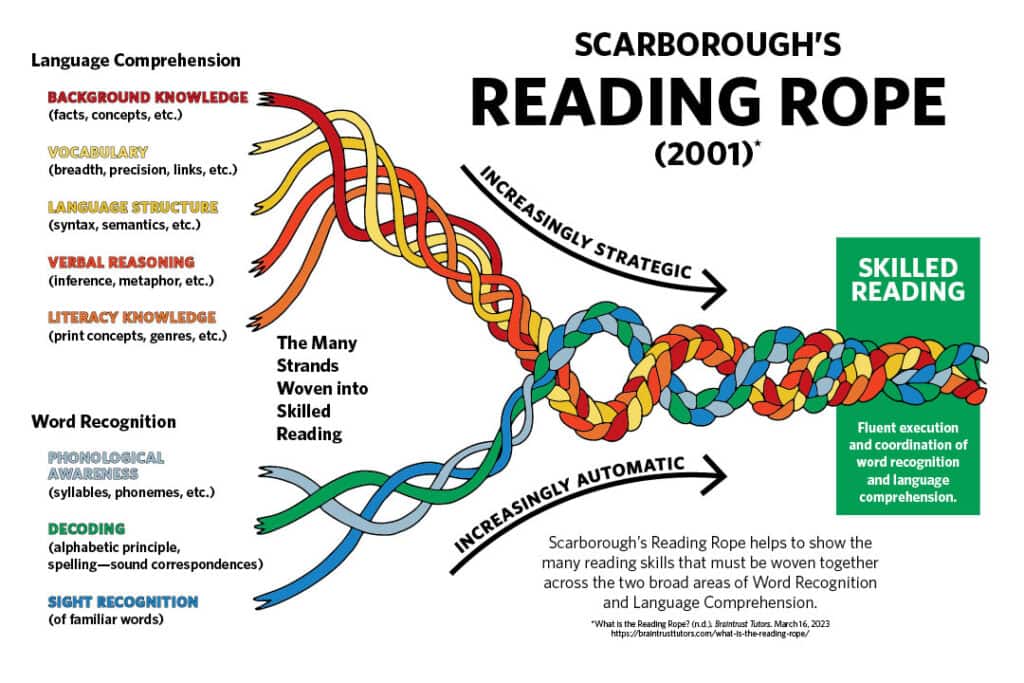
How background knowledge supports reading comprehension
First of all, background knowledge is any preexisting understanding of concepts, situations, ideas, and vocabulary that one can call upon when reading, according to the website We Are Teachers. Research shows that readers who have strong background knowledge on a variety of topics can better comprehend texts, make inferences, and generate appropriate connections.
Perhaps your child is a “word caller.” These readers sound fantastic, reading fluently, with expression, and could seemingly work for Audible as voice-over actors. The problem is when you ask them to tell you the main idea of what they just read. Often the child offers the real-life shrug emoji!
Why is this?
While their decoding skills are fine-tuned, their vocabulary may be weak. This becomes critical with homonyms – words that are spelled the same but can have multiple definitions. Further, the weak background knowledge prohibits the reader from making appropriate predictions or “reading between the lines,” and making inferences. And according to the National State Boards of Education, knowledge compounds, meaning children with more background knowledge tend to absorb and retain new information at a much faster rate.
Still not convinced of its importance? Reading Rockets conducted an experiment in which groups of low socioeconomic status students (SES) were compared with middle SES students for reading comprehension. Using the same texts, the middle SES cohort outperformed the low SES cohort in comprehension due to lack of relevant background knowledge about certain topics among the low SES cohort.
It just makes sense that a reader needs a certain level of information about a topic in order to properly comprehend a passage.
So how does a child develop it?
How to build background knowledge
Clearly, students need an adequate threshold of background knowledge in order to successfully participate in class discussions and comprehend challenging texts. The obvious question becomes: how do you this?
Read physical books. Interestingly, a study from Harvard attempted to demonstrate the importance of background knowledge to reading comprehension. A key finding – though not the main goal of the study – was that children comprehend more while reading physical books rather than digital sources. (Chalk one up for the “veteran teachers” who champion physical books!)
Topic-specific reading. Encourage your child to explore a topic of interest, such as space or dinosaurs or some time frame in history. Embrace multi-media. Yes, physical books (as referenced above) ought to be part of the research materials. However, sites like Youtube would certainly have a vast selection of content on most any topic of interest to your child. Work with your child to come up with a set of questions to explore in variety of formats to allow them to become “experts” of their chosen field.
Continue with read-alouds. While younger children certainly enjoy listening to an enthusiastically read rendition of a Dr. Seuss favorite, older children – upper elementary and middle school age – actually relish a read aloud too! By selecting advanced texts, it allows the parent/caregiver to offer higher level vocabulary words and the perfect opportunity to discuss what they mean.
Take real and or virtual field trips. Summertime provides some extra hours to explore your city and perhaps beyond. Museums, state parks, and historical areas are all prime locations for your child to add to their background knowledge. If traveling is not possible, virtual trips are just a few clicks away on your computer. Many of the most popular museums and places of interest around the world have websites with links to rich content. The American Museum of Natural History in New York City is one such example.
Question your child. As your child is reading and especially after they have read a text, offer up a few questions to determine how much they have comprehended. Not sure what to ask? Here is a link to 21 questions to get you started.
Encourage writing. While reading certainly is the main focus of our discussion, a powerful way to parlay that reading into meaningful, lasting and retrievable knowledge is to encourage your child to write down their thoughts. A key word is write. There are some recent studies that point to the effectiveness of handwriting information versus typing with respect to learning and retaining the information. Simply offering a new journal or notebook (with a teen heartthrob or latest pop music sensation on it) and a selection of pens and pencils can be enough motivation to spur your child to write.
Model reading. The old expression monkey see monkey do has endured for generations due to its simplicity and accuracy. At some point during the day, provide your child with the opportunity to see you reading, ideally a physical book or magazine. Yes, time is increasingly crunched in our modern society, but finding and allocating 10 to 15 minutes of modeling reading will pay off powerfully for your child’s literary background knowledge development.
Final thoughts
The research is clear: if you want your child to read and comprehend complex texts – like those featured in many high school classes and on college entrance exams – then you need to build background knowledge. Encouraging topic specific reading, coupled with complex read aloud texts along with inspiring them to jot their thoughts down in writing is a proven approach to building lasting background knowledge. Finally, building background knowledge pays big dividends. Students will be more confident participating in class discussions, will comprehend more challenging texts, and perhaps in the distant future, they may even win the Tuesday Night Trivia Contest, staged at their favorite local watering hole!
If your child struggles with reading comprehension and or seems to have a microscopic amount of background knowledge, contact Jennifer Disch at Engage the Brain to discover how a Learning Specialist could work with your child to develop these critical reading skills.