

Executive functions can be taught. What are they and some strategies for parents to try.
It’s December and New Year’s Day and resolution-making time are quickly approaching. As you begin to ponder some possible resolutions – lose weight, exercise more, eat better – perhaps there is a different approach you could take this coming year. Why not pledge to polish up your Executive Functions? After all, these are the set of skills that will allow you to accomplish ALL your goals. Or not.
Executive functions (EF) are a specific set of skills that we all need and use to succeed in life. They help us plan, organize, and manage our time to accomplish a goal. So what are they? The 7 executive functions are: adaptable or flexible thinking, planning, self-monitoring, self-control, working memory, time management, and organization.
Harvard University defines it this way. Working memory is the ability to hold information in your mind and use it. Inhibitory control is the ability to master thoughts and impulses to resist temptations and distractions and to think before acting. And cognitive flexibility allows us to switch gears and adjust to changing schedules and priorities.
Are you thinking of your school-age child right now, shaking your head and muttering something like, “I knew (fill in your child’s name) was smart but has just not been able to put it all together. It must be their Executive Functions!”
Unfortunately people are not born with them in place. They need to be developed. Like most skills, some people tend to pick them up rather easily while others struggle to meet their daily goals. The good news is EF skills can be taught!
Struggling Student with EF Weakness
What does a student with EF weakness look like? There is no one description but some common things a parent might see are:
- a messy backpack, locker, or desk space
- numerous missing or late assignments
- starting a long-term project the night before it is due
- forgetting about a test
Often these EF deficiencies reveal themselves early in a child’s schooling. Parents need to be aware of why their child is struggling, and more importantly, that there are tools and strategies that can be directly taught.
Strategies for EF Success
First and foremost, a student needs to be coachable. If a student is struggling in school due to an EF weakness, then they must be willing to try a different approach. Wasn’t it Einstein who said that trying the same thing over and over and expecting a different result was the definition of insanity?!
Fortunately there are tools and strategies that can be implemented.
1. Use a homework planner
Writing down assignments and due dates is critical for consistent success in school. Teachers today often post assignments on either a learning management system such as Canvas or on a school website. While the information is available, often students must look in more than one place to get all their assignments and test dates. Having it all written down in a homework planner keeps all assignments and the due dates in one place.
2. Make and use lists
Students who struggle to remember assignments or materials will benefit from using a list. A list could be created and placed on a student’s home desk that has all the necessary materials and tasks for a successful day of school. For example, the list may contain: homework completed; all papers, folders, and notebooks in backpack; laptop charged; all work submitted electronically. Another list could be taped in a student’s locker at school listing all materials that need to come home for the day after school.
3. Use apps
In today’s electronic, always-connected age, more schools are going to digital instructional platforms. Each student is presented with a laptop on the first day of school and virtually all work is completed on it. As stated above, there is still a place for good old-fashioned paper for homework planners and lists. However, there are some excellent organizational apps available to supplement planners.
Habit List – This app allows you to “build a better you.” (Who doesn’t want a better version of themselves?) In addition to setting goals, it proclaims to motivate you and keep you on track to achieving those goals. Students can track homework assignments, plan long-term projects, and set test dates. There is one time $4.99 purchase price.
Remember the Milk – This app purports to “get the to-do’s out of your head.” It is easy to use and allows you to assign a priority level to each entry. Reminders can be set to alert you of due dates via email, text, or social media. There is a basic free version with in-app purchases available.
My Homework – This app is designed specifically for students. Like the other apps, it allows the student to track assignments and long-term project due dates. It synchs across platforms, which is a nice feature given the variety of websites and learning management systems schools tend to use. There is a basic free version and a premium version available for $4.99.
Practicing Executive Functions with your Student
There are many fun activities parents can do with their children to promote their EF. Playing card games such as Uno or Hearts exercises working memory to track the cards. It tasks mental flexibility while planning strategy on how to win. Other card games like Spit or War that require quick decision-making are great for building attention.
Playing organized sports is another great avenue to building EF. Children must hold (sometimes) complicated rules and strategies in their minds while playing the respective game. And there is evidence that high levels of physical activity can improve focus and attention.
Encourage your child to take up an instrument. Playing an instrument challenges attention and self-monitoring and working memory to hold the music in their head. And if your child is more of a diva and prefers to be front and center, singing holds the same benefits, requiring coordination of working memory, monitoring, and selective attention.
And don’t forget brainteasers and puzzles. Crossword puzzles, Sudoku, and even the evil Rubik’s cube (mine may have ended up in a thousand pieces, but that it is not here nor there) all require a sophisticated mix of EF skills to solve. Lumosity and Cogmed offer excellent online options for students to practice a variety of EF skills.
Putting it All Together
Executive Functions are a complicated mix of brain skills required to plan, monitor, and achieve goals. An EF Coach who has been properly trained can teach them. Engage the Brain has several such experts on staff ready to help guide your child to school and life success, using the best in research-backed strategies. If your child is struggling in school, make it one of your New Year’s resolutions to contact us and start your child on the road to sustained school success.
Contact us to learn more.

Practicing gratitude has powerful benefits. Here are 6 simple activities to start your gratitude practice.
2020 has been a quite a year. COVID-19. Lock downs. Political divisiveness. Economic uncertainty. Do we want to forget this year, or do we want to remember it and embrace the many lessons it offered?
If you look closely and listen carefully, there has been some good. The choir of Who’s are singing in Whoville and the silver bell from the Polar Express still rings for those who choose to listen.
Who can hear these elusive and encouraging sounds? People who practice gratitude are who. People whose ethos is to live mindfully and who consciously acknowledge the small opportunities to say “thank you.”
Can’t hear these tranquil vibrations because 2020 has you too overwhelmed? Let’s see how you are doing. Take this Gratitude quiz to get a sense of where you are on the gratitude scale and then read on to deepen your understanding of the importance of incorporating gratitude into your daily life.
Benefits of Practicing Gratitude
Perhaps you are asking what the big deal about gratitude is. Let’s turn to science to help with that. According to Positive Psychology, there are a variety of reasons to make gratitude a part of your daily life. Among them are:
- improved physical health
- improved sleep
- increased empathy
- enhanced self-esteem
- more social connection
Learn to be Grateful in 4 Steps
Those are the benefits. How do you learn to practice gratitude or how can you teach your child? Mindful Amazing breaks it down into 4 distinct steps:
- Noticing – become aware of a person, place, or thing you appreciate. Did someone do something nice for you? Did someone give you something?
- Thinking – think about why the person did something for you. Think about all the reasons you are thankful for this person or gesture.
- Feeling – what are all the emotions you feel as a result of what you have been given? How do you feel? Happy, proud, calm?
- Doing – how will you express your gratitude to this person? What action will you take?
Gratitude Activities
Now you know the science-based, powerful reasons to practice gratitude and have a simple 4-Step Plan to implement it. As they say on television commercials… “But wait, there’s more!” Here is a series of activities that Engage the Brain curated from around the Internet that you could do to help establish your gratitude practice.
Gratitude journal
One of the simplest and most powerful activities you can do is start and maintain a gratitude journal. Jot down what you are grateful for. If you need motivation, there are Facebook groups that you can join and post a daily gratitude statement. Members of the group encourage each other and provide sources of inspiration.
Random acts of kindness
Performing random acts of kindness can provide us with a blast of a feel good hormone, dopamine. Random can equal simple. Return a stray shopping cart to the storefront or place it in its proper holding spot in the parking lot. Hold the door for a stranger as you enter or exit a building. Offer to help an elderly neighbor with their yard work.
Gratitude jar
Place a large jar in a visible location in your home. Perhaps there is room on the kitchen counter. Next to the jar place some small note cards or index cards that have been cut in half. Each member of the family can write down something they are grateful for and place it in the jar. Ideally each person contributes daily. Establish a time when the family is all together – maybe Sunday during dinner – and read the notes. Challenge your family to keep the practice going.
Photo collage
Just about everyone 10 years old and up has a cellphone or smartphone. And just about all of them have a camera. Challenge each family member to take pictures of things they are grateful for during the week. If so inclined, create a theme for the week. Possible themes include people, places, nature, or food. Pick a night during the week that each family member can share his or her photos.
Gratitude walk
Take a walk around your neighborhood with the intention of being grateful. Activate your five senses and focus in what you see, hear, smell, feel, and if appropriate, taste. Challenge yourself to notice things you have not seen before. The color of a neighbor’s house. A flower garden on the side of a home. The sound of kids playing in a backyard.
Putting it all together
2020 has been a year. Whether its been a roller coaster, an isolation chamber, or series of starts and stops of good-intentioned self-improvement – learning a foreign language, how to play the guitar, or bake pumpernickel bread – it is safe to say everyone is exhausted and ready for the return of “normal.” As we fight back and observe safety protocols, please remember to be grateful for the good that is still there. It takes practice, but the benefits are undeniable.
Engage the Brain is grateful for our families, schools, and most importantly our students, that strive every day to do their best.
Enjoy the holiday season.
Contact us to learn more about Engage the Brain and the services we provide to build confidence and academic success.

Does your child have dyslexia? Statistics, strategies, and debunking a few myths.
October was Dyslexia Awareness Month. Here at Engage the Brain, we aim to spread dyslexia awareness every month. We have a robust team of Learning Specialists who focus on students diagnosed with dyslexia employing the gold standard for instruction, the Orton-Gillingham method.
Many people are familiar with the term dyslexia and perhaps have some vague notion of its meaning. No, people with dyslexia do not see words backwards as if reflected in a mirror! More on dispelling myths later.
The International Dyslexia Association defines it this way: Dyslexia is a neurological condition caused by a different wiring of the brain. Students have difficulties with accurate and/or fluent word recognition and poor spelling and decoding. There is no cure! And there is no relationship to intelligence. Dyslexics are neither more nor less intelligent than the general population. Statistics are difficult to pinpoint, but according to LD Online between 5% and 15% of the population – 14 to 53 million children and adults – have dyslexia. Some sources even report up to 20%.
Success Stories
Like with many other challenges life throws at us humans, there are success stories for people to look to for inspiration. The following notable people reportedly had or have dyslexia:
Thomas Edison: he was a bright fellow!
F. Scott Fitzgerald: he could tell us stories about dyslexia
Stephen Spielberg: Close Encounters of the Dyslexic Mind
Charles Schwab: Invest in good instruction
(Sorry for the bad jokes!)
Intervention Approaches
The good news is that there are researched-backed approaches to teach reading skills to dyslexic students. There must be a systematic and explicit understanding of language structure and must include phonics. The Orton-Gillingham (OG) approach is one such method. According to the Academy of Orton-Gillingham Practitioners and Educators’ website, OG is a direct, explicit, multisensory, structured, sequential, diagnostic, and prescriptive way to teach literacy when reading, writing, and spelling does not come easily to individuals.
5 Myths about Dyslexia
1. MYTH: Dyslexics have defective brains
Not true. But nor do they special brains. They have different brains. The International Dyslexia Association (IDA) cautions against parents imparting too much emphasis on celebrity success stories, which could be damaging if a child does not meet certain expectations.
Early identification and intervention with appropriate accommodations along with the use of assistive technology ought to be the focus.
2. MYTH: Writing letters backwards is a sign of dyslexia
Some children do write letters backwards and some do not. Younger children tend to do this with b and d and or p and q. Understood.org recommends if your child is still reversing letters by the end of first grade, it may signal a need for an evaluation.
3. MYTH: Dyslexia can be out grown
Simply put this is false. Longitudinal studies have proven phonological challenges persist into adulthood. With proper instruction dyslexics can learn to read effectively but often continue to read slowly and not automatically.
4. MYTH: Dyslexia cannot be identified until third grade
Professionals with training in diagnosis can identify precursors to dyslexia as early as five years old. Definitive determinations can be made as soon as a child struggles to learn to read, write, and spell. The University of Michigan says evaluating a family history for dyslexia or other language-based disabilities can help identify vulnerable children even before they begin formal schooling.
5. MYTH: Dyslexia is a vision problem
Dyslexia is a language-based learning difference. Students with dyslexia are no more likely to have vision problems than those without it. Glasses or contact lenses may bring the text into focus, but they will not cure dyslexia.
Putting it all together
There are many wonderful resources to turn to if you think your child may have dyslexia. Early diagnosis and employment of a prescriptive, multi-sensory, and systematic approach to teaching phonics such as the Orton-Gillingham method is the best course to pursue. Engage the Brain has a team of trained experts that can answer any of your questions. Debunking the myths and arming yourself with information is the best course of action. As the IDA says, the environment a parent creates often determines whether a learning difference becomes a disability or a talent.
Contact us to learn more about our remote learning services.

Follow these eight strategies to succeed in your online classes.
Back in March, the COVID-19 pandemic sent students and teachers scurrying for the safety of their homes. Information about the coronavirus scared people into rethinking even the most basic reasons to leave the house. But for K-12 students, school had to go on.
Both teachers and students were thrust into an unknown and uncomfortable teaching and learning environment. Yes, remote classes existed and virtual schools had taught students for years prior to the pandemic. But in March virtually every student and teacher – most with no knowledge or the correct technology to support them – became members of the same virtual school.
For many this was a train wreck!
Teachers were frustrated because they had no training for this instructional delivery method. According to survey conducted by Class Tag, over half of teachers (57%) surveyed felt unprepared. Students were frustrated because their teachers suddenly seemed mortal and were presenting disconnected lessons with frequent technology glitches.
Engage the Brain scoured the Internet searching for answers. What follows are a curated collection of 8 tips to help students succeed in their online classes.
Understand the Platform
Students need to take the time to learn the platform their online classes will use. Whether it is Canvas, Blackboard, or Google Classroom, students need to be familiar with all the features of the system. They should know what to look for and where to find it.
Know how to contact their teacher
Each teacher will have his or her own preferred contact method. Some prefer email while others prefer a text. Learn the correct way to reach the teacher so when questions arise, there is no delay in receiving the desired information.
Asynchronous vs. Synchronous Learning
Now that school is back in session, ensure you know what delivery method the online school is using. Synchronous learning is essentially “live” instruction where a student is logged onto their device and a teacher is presenting lessons in real time. Perhaps other students in the class are logged on to the system at the same time. Asynchronous learning is typically recorded or prepackaged lessons that a student can access at a time of his or her choosing. Once the assignment is completed, uploading it to the system turns it in. Of course some instructional models may use a hybrid model and employ a combination of the two. If you are interested in learning more, here is a great article with more in depth information.
Create an organized workspace
Because a student is at home, it could be more challenging to create an appropriate workspace. What does a good home workspace look like? First, there ought to be a desk or table with a comfortable chair. Do not allow a student to participate in an online class from the couch or their bed in their bedroom. This is still school! Beyond a desk and chair, the space needs plenty of light and all the typical supplies: paper, pens, pencils, and any texts needed for the classes.

Stay organized
Once a good workspace is created, students need to stay organized. This includes the physical workspace itself, any notebooks or binders, and the digital files. As an online student, assignments will be created on the computer and turned in electronically. Very quickly in the school year, a student will amass a large amount of digital files. Create folders for each class and store completed assignments in the correct files.
Create a routine
Whether a student is participating in a synchronous or asynchronous learning environment, it is critical to develop and stick to a routine. This is especially true for online learners with learning differences. Starting the school day at the same time each day can help those learners with procrastination tendencies. Create a schedule that includes brain breaks, lunchtime, and a recess built in. To learn more about routines and students with learning differences, check out this wonderful article in Additude Magazine.
Use a planner, calendars, and alarms
Meeting deadlines and turning in assignments on time can be more challenging for online or virtual students. Use of a planner can help a student record all the assignments along with their due dates. Supplement the planner with technology. Students can set alarms on their smartphones to help remind themselves of long- term assignments. A monthly calendar can be used to help visualize all assignments and personal responsibilities. For example, if a student plays a sport games can be recorded on the monthly calendar.
Reward yourself
Online learning can be isolating for a student. Therefore it is important to celebrate successes and milestones. If a student does well on a test, project, or a research paper, celebrate the accomplishment. Go out for ice cream or allow your student extra video game time. Make it special!
Conclusion
COVID-19 has disrupted the delivery of education and just about every aspect of our lives. Schools have had to innovate in real time. Given all the uncertainties, many parents are opting to home school or utilize virtual school options. Students have had to adapt to new learning methods. Sustained success is attainable. Following these 8 tips will put your student in the best position to succeed in their online learning classes.
Contact us to learn more about our remote learning services.
Key Health & Wellness Protocols at our Tutoring Center
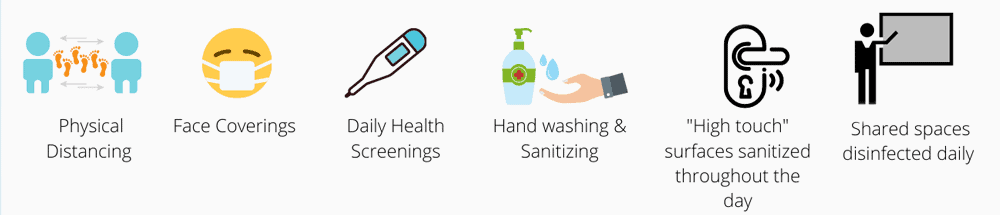
Upon arrival at our tutoring center, all entering the area, including learners and faculty, will have their temperature taken. Continuous hand washing and sanitizing of high touch surfaces. Shared spaces and materials will be disinfected daily.
We require families and faculty to conduct a DAILY HEALTH SCREENING:
Please self-screen every day before coming to school. Stay home if you are ill or have any of the following symptoms.
- Fever (temperature of 100⁰F or greater). Students should not be medicated prior to checking for a fever. Do not send your child to school medicated for a fever.
- Shortness of breath or difficulty breathing
- Cough
- Sore throat
- Runny nose or nasal congestion
- GI symptoms like nausea, vomiting, or diarrhea
- Loss of sense of smell or taste
- Generalized body aches or generalized weakness
- Disequilibrium, such as dizziness
- Chills (sometimes with shaking)
- Headache
- If you have been in close contact with someone with COVID-19, you must stay home for 14 days after exposure. Additionally, contact the Engage the Brain office and call the Florida Department of Health 1-866-779-6121 for guidance regarding presenting symptoms to determine if testing for COVID-19 is recommended.
COVID-19 policies, in particular, are intended to mitigate, not eliminate, risk. No single action or set of actions will completely eliminate the risk of COVID transmission, but the implementation of several coordinated interventions can significantly reduce that risk.
Contact us with questions.
As parents we want our children to succeed in all areas of their lives: academically, socially and emotionally. Most (hopefully all) parents want to raise smart, happy, healthy kids. But inevitably during the course of growing up, kids are going to hit some bumps in the road. When one of those bumps is in school, it may be time to call for outside help in the form of a tutor.
How do you decide if your child needs a tutor?
Engage the Brain has identified four occurrences when parents may want to consider hiring a tutor:
- Slipping Grades – One bad test grade does not signal a failing child. Look at your child’s grades over the course of 9 weeks. Is there a pattern of poor grades? Is your child struggling to keep up?
- Change in parents’ schedule – Do you have the time to devote to assisting your child with their academic struggles? If both parents work full time jobs, it may prove too much to balance all the requirements running the household and provide academic support?
- Parents’ lack of content knowledge – As children enter middle and high school, subjects simply become more difficult. Add in all the Common Core teaching principles and even elementary school subjects can be confusing! Assess your own subject knowledge before attempting to help your child tackle honors Algebra.
- Child with a learning disability – If you have a child with a diagnosed learning disability, you are better to hire a professional whom specializes in teaching children with learning differences. Dyslexia, processing issues or even ADHD each requires special techniques and instructional strategies to help a child achieve success in the classroom.
If after careful assessment you decide your child needs a tutor, you want to begin talking with your child’s teacher. Ask for specific areas your child needs help with. Share this information with the tutor. With your permission, a tutor can speak directly with the teacher and perhaps receive even more information to help your child.
Besides addressing a struggling subject, tutoring has many other benefits.
- 1 on 1 instruction – Instruction in classrooms can go fast and with 20 or more students in the room, teachers can struggle to provide 1 on 1 instruction to each student. Tutors work with one a student at a time and devote all their expertise to your child.
- Avoid the parent-child homework battle – Every parent that has ever tried to help their child with their homework has experienced the same volcanic reaction: MRS.JONES DOESN’T TEACH IT THAT WAY!!! screams your innocent angel of a 4th grader. It may be worth the cost of a tutor to not have to experience these meltdowns.
- Immediate feedback – All educators agree that immediate feedback is critical in the learning process. Again, this is not a knock on teachers, they are extremely busy, but a child can take a test and not receive the grade for several days or longer. With a tutor you child receives immediate feedback while working on a concept.
- Opportunity to become a better learner – Great tutors provide a child with tools to use in the classroom to achieve success. Study strategies and techniques can be taught simultaneously while working on specific subject concepts. For example, your child will learn she needs to study for four nights for 30 minutes a night for a test rather than for two hours the night before a test. She can apply this study strategy to all her classes.
- Gives child permission to struggle – Children are painfully aware of how their peers perceive themselves. If a child thinks everyone in the classroom is aware they are having a hard time, it will affect their performance. Tutoring allows your child the opportunity to struggle with a concept in a safe environment. Within the safe environment your child can build his confidence back and become successful.
- Enrichment opportunities – Tutoring does not have to be just for struggling learners. All children benefit from studying topics of interest to them. Schools and teachers are under more pressure than ever to prepare students to pass high stakes tests. Opportunities to study subjects of real interest to students in depth often times is not available. A tutor can work with your child to create an individualized enrichment plan that can integrate all the core subjects – reading, writing, math, history, etc. and provide a rich learning opportunity for your child.
Wrapping it Up
Determining whether your child needs a tutor can be a daunting task. Start by honestly assessing your own schedule and skill set. Next, speak with your child’s teacher to ask for specific suggestions for help with the struggling subject(s). Hiring a tutor has many positive benefits that go beyond just raising a subject grade.
Contact Engage the Brain to learn more about our professional tutors and our independent learning programs that meet individual needs.
Much has written about the Summer Brain Drain or summer learning loss. Just Google “Summer Brain Drain” and pages of useful, semi-useful and many useless articles appear.
Engage the Brain is going to separate the men from the boys. The wheat from the chafe. The junior college from the Ivy League. The franchise learning centers from Engage the Brain. Yes, we went there.

Summer Brain drain is real.
It is well researched that the average student loses two to three months of learning over the summer. The loss is more pronounced in minority and low-income families.
Why so much loss?
It can be summed up in the old saying, “If you don’t use it, you lose it.” Most children do not read enough over the summer. And very few children do any type of math computation or problem solving. Hence the learning loss. Short of sending your child to summer school or to an expensive academic camp, what can a parent do to help their child maintain the academic skills they learned during the past school year?
Here are two key antidotes to the Summer Brain Drain:
- Establish an atmosphere that learning is a life-long process. Help your child understand that learning can take place EVEN when school is out.
- Schedule time each day for your child to relax and read or play a learning game. The time can be as short as 15 minutes or as long as an hour. Tweak the time depending on the age and attention span of your child.
Let’s look at some activities you can do with your child to help foster a sense that learning can take place anywhere at any time.
Plan a vacation
Whether it is a one-day “Staycation” or a plane flight to a far off destination, planning a vacation involves lots of academic skills. Children can research where they would like to go (reading), determine how much it will cost to attend certain attractions (math), and figure out how to get to said attractions (geography).
Pen pal with a relative or friend
Writing for a purpose is at the crux of communication. Encourage your child to write to Grandma or Grandpa or another distant relative and to start a dialogue between the two. My daughter corresponded with my father (her Poppop) for years through letter writing. Every couple of letters that arrived at our home contained money! Writing involves rereading what has been written; a sneaky way to get in more reading practice.
Social Learning
How can I put this so that I don’t insult anyone? Many teachers have a similar complaint about today’s students… They simply don’t SHUT UP. Was that too blunt?
A few weeks ago I wrote a blog post on the importance of teaching kids soft skills. A great way to practice soft skills would be to visit a museum in your area. Participate in a guided tour, if one is offered. Your child must listen and will be given opportunities to ask the guide questions. If there are other kids along on the tour, encourage your child to chat with them. Developing social skills is critical for long-term success in life. Summer is a wonderful time focus on this.
Wrapping it up
Summer provides more opportunities for meaningful conversations to take place with your child. Help him understand learning is a life long process by including him in decision making about his summer activities. Structure the day so that there is a consistent down time during which he can read or work on an educational computer game. Your child does not have to fall victim to the Summer Brain Drain. Just employ a few of these antidotes so you child arrives in class this fall charged and ready to learn.
David Karch (Learning Specialist with Engage the Brain)
It’s the first week of May and that means it is Teacher Appreciation Week. And IMHO (in my humble opinion) teachers should be appreciated more than ever.
High stakes standardized tests. Teacher evaluations tied to those high stakes tests. School grades based on the tests. Most teachers put and keep a smile on their face and continue to inspire, challenge and teach each and every student in their classroom despite all the outside pressures.
The good news is that those pesky high stakes tests are now over for this year and everyone in your child’s school can take a deep, collective, cleansing breath. In through the nose… Out through the mouth.
Are you relaxed? Yes, keep reading. No, repeat deep cleansing breath then keep reading.
Have you thought about what to get your child’s teacher for Teacher Appreciation Week? If not, Engage the Brain has you covered. We have scoured the Internet and curated some of the best ideas and suggestions. These easy teacher appreciation git ideas are put into two categories: Ideas for the Classroom and Ideas for the Teacher.

Photo courtesy of signupgenius.com
Money and time is always a consideration. The suggestions in each category have a range of costs and preparation time. Pick accordingly.
FYI (For your information) these are NOT Pinterest ideas. These suggestions are for the mere mortal parents who want to do something to acknowledge their child’s teacher, not turn this week into an homage to Martha Stewart. If you are THAT parent, you don’t need our help!
Ideas for The Classroom
Publix Gift Card
It is well documented that teachers spend several hundred dollars of their own money each school year on supplies for the classroom. Purchasing snacks for students who forget theirs or treats for celebrations make up a good chunk of the money. A Publix gift card will allow the teacher to restock their “classroom pantry.”
Whiteboard Markers/Erasers
Even with Smartboards and other technology entering the classroom, teachers and students still use the whiteboard and markers. In fact, some teachers give each student an individual whiteboard the size of a clipboard to use during class. Each student needs markers. Unfortunately the markers wear out and are expensive to replace. Target sells a pack of 4 markers for about $5.00.
Hand Sanitizer and Kleenex
There is never enough Kleenex and hand sanitizer for a classroom. When cold season starts going around and through the students, these two supplies seem to constantly run out.
Books for classroom library
Most elementary school classrooms and some middle school classrooms have a classroom library. Purchasing a book or several books to be placed in the library is always a welcome gift for the teacher. Not sure which books to get? Ask your child what books he would like to read and purchase those.
Ideas for the Teacher
Spa Day/Massage
Most teachers are on their feet all day walking the classroom. One moment they are scowling at the two boys in the back of the class who are not paying attention and the next reteaching how to divide fractions to a student in the front row. A massage would be a welcome treat to regenerate a teacher’s spirit and tired body.
Provide lunch
School lunch schedules are short and hectic. After dropping the students off at the cafeteria for lunch, many teachers go make copies or prepare and set up the classroom for the afternoon lessons. Often lunch is forgone for an unhealthy, quick snack. Treat your child’s teacher to a lunch from a favorite, local restaurant.
Ornaments/Coffee mugs
As a former classroom teacher, and someone who is married to a classroom teacher, I can say first hand coffee mugs and Christmas ornaments are treasured gifts. Each time a coffee mug is used, it brings back memories of the student and class from that year. At Christmas time when we decorate the tree, we each have a section of the tree where we hang our student ornaments.
Handwritten Thank you notes
If you want to make a classroom teacher misty, write a heartfelt thank you note. Acknowledge all the hard work the teacher has done this year to help your child succeed. Hallmark may hire the best writers to convey messages, but a simple thank you written in your own words sends a powerful message that you appreciate the teacher’s effort with your child.
Wrapping it up
Teachers are the unsung heroes among us. They tend to be over worked and under paid. The first week of May is Teacher Appreciation Week and this provides the perfect opportunity to thank your child’s teacher. You can purchase something for the classroom or provide something special for the teacher. Whether you splurge and purchase a full day spa treatment or write a short thank you note, it truly is the thought that counts.
David Karch (Learning Specialist with Engage the Brain)
In the past 10 to 20 years, “Big Data” has entered the K-12 education practice field in a loud and demanding way. Accountability through high stakes test scores, teacher evaluations and school ratings is at the core of Big Data. Improve the numbers and our schools and children will succeed, goes the thinking.
“Numbers don’t lie,” goes the saying. But one can look at any number of different studies and the cited statics and conclude that test scores are going up, test scores are going down and or the sky is falling.
One thing most reasonable people agree on is wanting our children to graduate high school college and or career ready. To that end the focus has been understandably on the “Hard Skills” – Reading, writing and math.
But employers and colleges are still complaining that students or employees – our children – are still not ready.
Enter the “Soft Skills.” Soft skills are defined as EQ or Emotional Intelligence Quotient. These skills include: social graces, communication abilities, language skills, personal habits, cognitive or emotional empathy and leadership traits.

The National Career Service polled a sample of employers across different industries and asked what skills they want in their future workforce.
Here is what companies’ desire:
Communication skills, the ability to make a decision, showing commitment, time management skills, leadership skills, problem solving skills, being a team player, and the ability to work under pressure.
How many of these skills are measured on the high stakes tests our kids are currently taking?
The good news is that soft skills are teachable. The National Collaborative on Workforce and Disability (NCWD) is a wonderful website with great information for parents. The site spells out the different soft skills and suggestions for working on them with your child.
Here are a few highlights
Communication skills –
Record your child playing a video game with a friend. Review the video and discuss voice level and tone.
Have your child interact with adult guests in your home. Your child can take the beverage orders, which requires listening and remembering.
Help your child build his vocabulary with The Word of the Day exercise on an online dictionary.
Interpersonal Skills
Play games as a family. Board games are a great way for a parent to model appropriate social skills, especially when there is winning and losing involved.
Encourage your child to participate in school activities such as the debate team, act in the school play or join a sports team.
Volunteer as a family at a local charity. Your child will learn how to interact with people from different backgrounds than their own.
Wrapping it up
The soft skills can be viewed as the glue that keeps a person together. Once your child masters her reading, writing and arithmetic, Big Data would have you believe she is ready to succeed. A simple conversation with employers tells us that is not true. The soft skills of determination, resiliency and flexibility are critical for success in life, but these do not get measured on the high stakes tests.
Engage the Brain encourages parents to work on improving their children’s soft skills to complement the hard skills. With consistent practice you can raise your child’s EQ score and help her become completely college and or career ready.
David Karch (Learning Specialist with Engage the Brain)
It’s 8:15 p.m. on a Tuesday evening. Your high school son is sitting at the kitchen table. Swear words are getting louder as are the dramatic sighs and shuffling of the papers on the table.
You go through your parental decision making process … Do I say something about the inappropriate words flying out of his mouth…? Then you notice the algebra textbook in front of him and that he looks like he is about to have a nervous breakdown.
You quickly assess your own math skills. You notice it’s now 8:40 p.m. and say to yourself, “Blank it. I don’t know that blank either.” His blank is on his own.”
There is a lot of research coming out about the connection between a parents’ view of math and their ability to do it and the achievement levels of their kids. You can read about it here and here. In other words, kids who struggle with math likely have parents that struggled with math.
And it’s not just a genetic thing. It’s parents’ musings in front of the kids about their struggles with math that children hear and believe they too will struggle with the subject.
As a Learning Specialist with Engage the Brain, I find myself having to monitor my own conversations when I work with students on high school level math. Math was not my strong subject, but I am trying hard to reframe my thinking and attitude toward the subject.
I now attempt to frame math as a challenge. I might say to a reluctant math student, “Okay. We know two things and we need to find the third piece of information. How can we organize our information to help us determine the missing number?”
But what happens when me and my positive math-attitude get stuck and I still cannot find the answer?
I turn to technology. And so can you!
The answer, and an explanation, is just an app away. The saying, “There’s an app for that” even applies to Algebra and higher-level math.
Engage the Brain researched math apps that go beyond practicing skills and playing games. While there is a time and place for those, the following math apps actually solve an algebra problem for you. And show you how to do!
Math Apps
Photomath Camera Calculator Free
The words ‘brilliant’ and ‘genius’ get thrown around too often, but the adjectives apply for this app. You simply point your phone’s camera at the problem in the textbook, take a picture, and the app solves the problem. And it provides a step-by-step explanation of how to solve the problem.
FX Algebra Solver Free
This apps works like a search engine. You type in a math problem and it calculates the answer. It shows step-by-step instructions on how to solve it. It can explain pre-algebra, algebra and algebra 2 level problems.
Mathway Math Problem Solver Free with in app purchases available
Mathway takes solving those pesky math problems a step further. On the dashboard you select the math class your child is enrolled in: pre algebra, algebra, geometry, etc. Next, there is a selection of math problem templates from which to choose. For example, if the problem looks like this: y = ½ x + 4 select the template that looks similar. Just plug in the numbers, and the problem is solved!
Bonus app
Have you bought your child a graphing calculator? Were you as floored as I was when you saw the price? Unfortunately that is one of the prices of being a parent with a child in high school. But as they say on late night television…
Wait! There is more…

A math app that is a graphing calculator
Now your child can download a free graphing calculator right to his smartphone. It performs all the same functions as the expensive ones including: square root, cubed root, unit conversion, and even constants for scientific calculations such as the speed of light and the strength of gravity. Impressive stuff!
Wrapping it up
Parents can unwittingly affect their child’s performance in higher-level math classes by proclaiming their struggles with the subject when they were in school. The research is clear that children need to hear positive reinforcement and that their math destiny is not sealed by their mom or dad’s inadequacies with the subject.
When those inevitable math struggles come up during homework, now you can offer your child a tool to help in the form of a math app. By taking a picture of a math problem or entering it into a search bar, the app does all the heavy lifting by calculating the answer AND showing the steps to solve it. Turn yourself from a negative math ninny into a problem solving 21st Century parent by downloading one of these math apps.
David Karch (Learning Specialist with Engage the Brain)