

When parents read picture books aloud to their kids, attitudes towards math, interaction with math concepts, and school performance all improve.
They say a picture is worth a thousand words. But can a picture convert a child from being a numeral-phobic, math-loathing, number-avoiding, anti-calculating kid into a math-loving, pattern-seeking, shape-identifying, adding-subtracting-multiplying-dividing guru?
The right picture books can!
There are many reasons to use picture books for introducing and teaching math concepts. Typically they are written to entertain and are non-threatening for math. Many stories are populated with lovable animal characters and or adorable children who are out on adventures. Numbers, shapes, patterns, and even measurement come to life as these tales unfold. And even higher level math skills can become more approachable and understandable when using the disarming pedagogical technique of reading aloud picture books.
The research behind using picture books
According to a study by the American Psychological Association, the strongest predictors of later achievement are school-entry math, reading, and attention skills. A meta-analysis of the results of the study shows that early math skills have the greatest predictive power, followed by reading and then attention skills. Think about that – early math skills such as number recognition, counting, and sorting are stronger predictors of future success than even reading!
Another study of using picture books to teach math, found that student attitudes towards math along with their academic performance improved when picture books were used to teach math concepts. Further, research suggests that learning within a story context increases the retention and recall of the learned knowledge (e.g., Mishra, 2003). In laymen’s/laywomen’s terms, this is a win-win!
How to use picture books for math instruction
First of all, there is no wrong way of using any picture book to teach math. If you are reading them aloud, and your child is enjoying the story, you are already succeeding! But to get more out of the stories, get your kids asking questions. The Development and Research in Early Math Education at Stanford University suggests using two different types of questioning:
Lower level are simple and concrete. Examples are basic recall and labeling. How many birds do you see on the page?
Higher level are complex and abstract. Examples are to predict or infer. How many birds do you think will be on the next page? Why?
Use a mixture of these two types and ask follow up questions. Finally, model complex thinking.
Dr. Carrie S. Cutler, author of Math-Positive Mindsets suggests reviewing various parts of picture books before selecting them for math purposes.
When selecting books consider:
Accuracy: How accurate is the factual information? Terminology used correctly?
Visual appeal: Does it look like a textbook or a story book?
Connections: Provides contexts for readers to make connections between the math presented and their own experiences.
Audience: Presents concepts to a range of ages and abilities.
Interest factor: Goes beyond predicable; offers a new or exciting view.
Research Schools Network states the importance of how you use a book is important. Do not just read it. “Crucially, this means engaging in sustained back-and-forth multi-turn conversations, encouraging children to talk about the skills and concepts they are learning.”
Indeed, make it fun. Get the kids talking and asking questions.
Books to teach math concepts
Now you know the research and are convinced to use picture books, but where do you start? Engage the Brain has put together these particular books through Dr. Cutler’s considerations, and here is the perfect list to get you going:
Are We There Yet, Daddy? by Virginia Walters
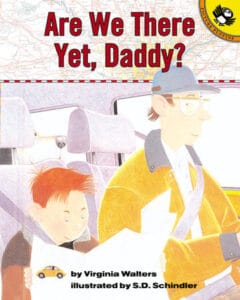
On a 100 mile car trip, a son learns about spatial awareness and distance by counting by tens and asking the incessant question, “Are we there yet?”
Sir Cumference and the Dragon of Pi by Cindy Neuschwander Illustrated by Wayne Meehan

The characters Sir Cumference, Lady Di of Ameter, and Radius travel through a castle in an adventure that leads them to a magic number about all circles. If your kid(s) enjoy this one there are more in a series.
One Big Pair of Underwear by Laura Gehl & Tom Lichtenheld
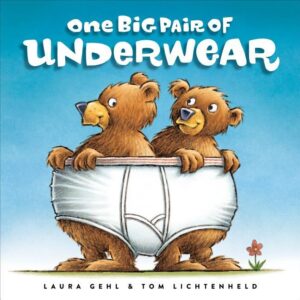
Counting, subtracting, patterns and silliness come to life in this funny adventure. What child doesn’t smile when you say the word “underwear?”
Elevator Magic by Stuart J Murphy, illustrated by G. Brain Karas
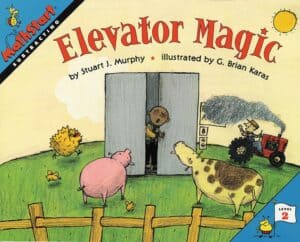
Subtraction comes to life as the character Ben travels down an elevator and opens the door to various scenes. Predicting what comes next adds to fun.
Anno’s Counting Book by Mitsumasa Anno

Great for the youngest mathematicians. Each page adds more details to correspond to a number.
Who Eats First? Ae-he Yoon, illustrated by Hae-Won Yang
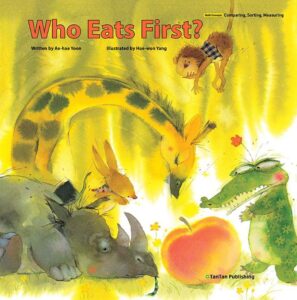
Classification, organizing data, and predicting come to life as a variety of animals decide who gets to eat a delicious peach first.
How Many Jellybeans? by Andrea Menotti, illustrated by Yancey Labat

Using candy and great pictures, kids can count large numbers.
100th Day Worries by Margery Cuyler, illustrated by Arthur Howard
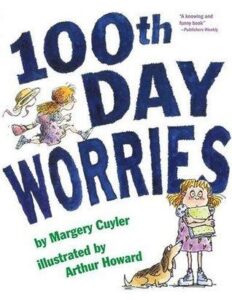
Alice, the main character, needs to find 100 things for the 100th day of school, but she cannot decide what to bring.
100 Hungry Ants by Elinor Pinczes, Illustrated by Bonnie MacKain
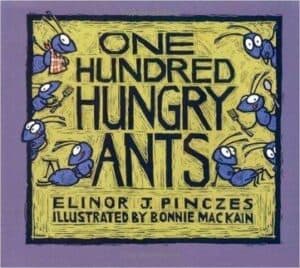
Ants introduce some slightly higher level math concepts including factors, prime and composite numbers, square numbers, and skip counting.
How Much is a Million? by David M. Schwartz, Illustrated by Steven Kellogg
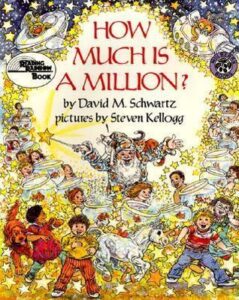
The book offers concrete ways to picture one million. For example, to count from one to a million, it would take about 23 days!
Higher level math skills
The Grapes of Math by Greg Tang, Illustrated by Harry Briggs
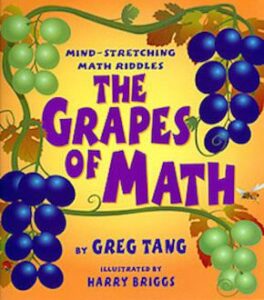
Teach problem solving in a fun and creative way. Visual cues help readers discover new ways of grouping numbers to make then easier to count.
Great Estimations by Bruce Goldstone
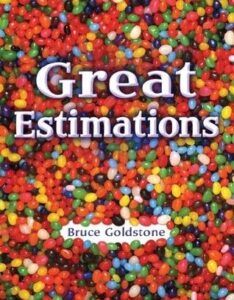
This book uses jellybeans to help teach readers how to estimate large quantities of items. With practice and techniques you could win an estimation contest one day!
The Greedy Triangle by Marilyn Burns, Illustrated by Gordon Silveria
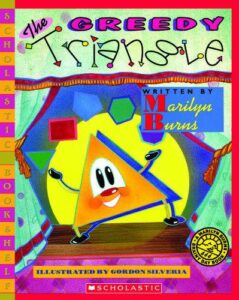
Follow along on an adventure when a bored triangle visits a shape shifter and he starts to grow and change. Readers learn about polygons and angles as a triangle continues to add sides to his shape.
One Grain of Rice by Demi
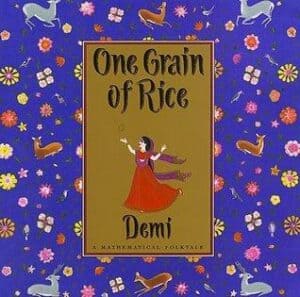
Readers learn about exponential growth as the main character takes a grain of rice and begins doubling it. The amount of rice quickly adds up.
The Math Curse by Jon Scieszka, Illustrated by Lane Smith

Math is everywhere and readers learn about patterns, fractions and even Fibonacci numbers.
Final thoughts
There are so many fantastic reasons to use picture books to teach math skills. By introducing children to math in non-threatening ways, their attitudes towards the subject improves, they are more willing to engage in math conversations and their classroom performance will improve. But just reading them is not enough. Encourage your kids to ask questions… get them talking! As a bonus, select these books from your local public library (these structures
still exist, right?). Now you are spending quality time with your child and introducing them to a love of reading. After reading a few of them, return to the library and select the next group.
If your child struggles with math concepts, please contact Jennifer Disch at Engage the Brain to discover how a Learning Specialist can help your child discover a love of math by using multi-sensory tools and picture books.