

What exactly is self-esteem? And seven ways to boost it for lasting effect.
Life has many puzzling questions such as: Which came first, the chicken or the egg? or How do you get a job with no experience but, then how do you get experience without a job? The same quizzical paradox can be applied to self-esteem. Do you need self-esteem in order to succeed, or do you need to earn success to foster self-esteem?
The answer to this question can help parents effectively boost their child’s self-esteem. Children who think and learn differently often struggle with self-image and thinking about themselves in a positive way. Even if a child does not have a learning difference, there is a clear and present mental health crisis with today’s youth and many kids’ self-esteem is in desperate need of first aid.
Self-esteem defined
What exactly is self-esteem? Young Minds defines it this way. First, a person feels good about themselves most of the time. Second, they believe in themselves and their qualities and strengths. And finally, they believe they are worthy and deserving of all the good things in life, including love, friends, and wonderful experiences.
Having a healthy self-esteem is important for children for many reasons. Perhaps most critical is that it allows them to cope with mistakes. Failure is a part of life and learning how to deal with it appropriately stems from a positive belief in ourselves. Children with poor self-esteem may let others mistreat them and or may have trouble joining in social activities. Finally, possessing a healthy self-image encourages kids to try new things. It makes school more palatable, knowing one has the ability to tackle potentially challenging concepts.
What causes low self-esteem?
Of course there is no one single contributing factor that causes low self-esteem. As mentioned above, kids who think and learn differently have often built up scar tissue from repeated failures in school and subsequently develop a poor self-image; they are wounded learners.
Children’s Medical Center attributes low self-esteem in children to their feeling unsupported or criticized by important people in their lives, especially their parents. No parent is perfect, and most if not all will at some point allow a hurtful exchange to take place between themselves and their child. However, a steady stream of critical comments will take their toll.
Another reason children’s self-esteem can suffer is due to academic pressure. As kids reach middle school and high school they become more acutely aware of how they measure up to peers. If that comparison falls short, negative feelings can take seed and grow.
Yet another factor is a chemical imbalance or other underlying health condition, which can cause anxiety and depression. If a parent believes they are doing all the right things and supporting their child, perhaps a discussion with the pediatrician is in order.
Further, Young Minds encourages parents to watch the words they use when labeling their child. Of course, avoid such terms as naughty, stupid, ugly, bad and weird. When a child makes a mistake, do not criticize. Rather, use it as a teachable moment and help your kid learn how to handle the situation better the next time. And finally, do not put too much pressure on your child to succeed at every single thing they try. Notice when your child tries something that they are not particularly good at and compliment their effort.
Finally, with ever present social media, kids are comparing themselves to their peers more than ever. Many children are not savvy enough to recognize that social media can be a careful curation of the best of someone’s life, which many teenagers are brilliant at producing. Feelings of unworthiness and emptiness can percolate and land as shortcomings, which can foster low self-esteem.
Signs your child is suffering from low self esteem
Parents know their child best. And if something seems off in their mood and or behavior, they may be wrestling with low self-esteem. Your child may:
- say negative things about themselves
- make negative comments about their appearance
- withdraw from social activities
- seem extremely anxious when they make a mistake
- increase complaints about physical ailments including headaches and stomach aches
- change their sleep routine to either more than or less than usual amounts
This is in no way meant to be an exhaustive list nor be conclusive that if a child is exhibiting one or more of these descriptors they are suffering from low self-esteem. But the list certainly is a starting point for a conversation with your kid.
Ways to boost self-esteem
As referenced at the beginning, self-esteem is a tricky concept. One’s self-image typically improves as one’s sense of agency and sense of control take hold. Helping your child find something they are good at is a great place to start, too.
Some research backed approaches include:
- Show unconditional love and support
This is especially important if you suspect your child is suffering with their self-image. Hugs and encouraging words are first aid for the hurting child.
- Help them learn how to fail and to respond to it appropriately
Kids with low self-esteem may feel like the sky is falling if they fail a test. Assist them in adjusting their perspective and how the test is just a score on one set of information. How will they study differently for the next test?
- Give responsibilities that prove successful
Most kids respond well to having chores around the house. Make sure you teach your kid exactly how to complete the task and what success looks like when it is done. For example, if the chore is to keep their bedroom clean and organized, take a picture of a clean version of the room so they know exactly what the expectation is. Support them in the beginning with forming a plan and working in steps. Gradually release full responsibility to your child.
- Identify and challenge negative thought patterns
When you hear your child announce a negative thought, point it out and challenge its validity. If your child is looking at a classmate’s Instagram page and lamenting that your family never travels anywhere, remind your child that your family values time together and the location of that bonding time is not important.
- Foster independence
Developing agency and the belief that their actions do make a difference in their life is critical to building a positive self-image. To that end, provide the necessary structures and support when your child is learning a new skill or taking on a responsibility. Use the classic teaching model of I do – We do – You do to promote independence.
- Mindless/pointless praise can actually do harm
Be surgical with your praise. Focus on effort, not outcomes. Most kids have a razor sharp BS antenna and will know and recognize hollow compliments, which could be internalized as They know I can’t do anything well.
- Encourage them to be kind to themselves
In order for them to be kind to themselves, they must first feel good about themselves. If you hear negative self-talk such as I am so dumb I can’t pass a spelling test, immediately call them out on it. A great conversation starter is: Would you say that to a friend? If not, then we do not say that to ourselves. Repeated negative self-talk and self-berating will take its toll.
Final thoughts
Because so many children are struggling with their mental health, focusing on your child’s self-esteem is a wonderful way to nurture and promote a positive self-image. By being intentional in your praise, teaching your child how to handle failure and to use it as a learning opportunity, and by fostering and promoting independence, you will allow your child’s self-esteem to grow in a lasting and effective way.
If you feel like your child is struggling with their self-image due to academic concerns, please contact Jennifer DIsch at Engage the Brain to discover how a Learning Specialist could help your child learn tools and strategies to become a confident and successful student.

When parents read picture books aloud to their kids, attitudes towards math, interaction with math concepts, and school performance all improve.
They say a picture is worth a thousand words. But can a picture convert a child from being a numeral-phobic, math-loathing, number-avoiding, anti-calculating kid into a math-loving, pattern-seeking, shape-identifying, adding-subtracting-multiplying-dividing guru?
The right picture books can!
There are many reasons to use picture books for introducing and teaching math concepts. Typically they are written to entertain and are non-threatening for math. Many stories are populated with lovable animal characters and or adorable children who are out on adventures. Numbers, shapes, patterns, and even measurement come to life as these tales unfold. And even higher level math skills can become more approachable and understandable when using the disarming pedagogical technique of reading aloud picture books.
The research behind using picture books
According to a study by the American Psychological Association, the strongest predictors of later achievement are school-entry math, reading, and attention skills. A meta-analysis of the results of the study shows that early math skills have the greatest predictive power, followed by reading and then attention skills. Think about that – early math skills such as number recognition, counting, and sorting are stronger predictors of future success than even reading!
Another study of using picture books to teach math, found that student attitudes towards math along with their academic performance improved when picture books were used to teach math concepts. Further, research suggests that learning within a story context increases the retention and recall of the learned knowledge (e.g., Mishra, 2003). In laymen’s/laywomen’s terms, this is a win-win!
How to use picture books for math instruction
First of all, there is no wrong way of using any picture book to teach math. If you are reading them aloud, and your child is enjoying the story, you are already succeeding! But to get more out of the stories, get your kids asking questions. The Development and Research in Early Math Education at Stanford University suggests using two different types of questioning:
Lower level are simple and concrete. Examples are basic recall and labeling. How many birds do you see on the page?
Higher level are complex and abstract. Examples are to predict or infer. How many birds do you think will be on the next page? Why?
Use a mixture of these two types and ask follow up questions. Finally, model complex thinking.
Dr. Carrie S. Cutler, author of Math-Positive Mindsets suggests reviewing various parts of picture books before selecting them for math purposes.
When selecting books consider:
Accuracy: How accurate is the factual information? Terminology used correctly?
Visual appeal: Does it look like a textbook or a story book?
Connections: Provides contexts for readers to make connections between the math presented and their own experiences.
Audience: Presents concepts to a range of ages and abilities.
Interest factor: Goes beyond predicable; offers a new or exciting view.
Research Schools Network states the importance of how you use a book is important. Do not just read it. “Crucially, this means engaging in sustained back-and-forth multi-turn conversations, encouraging children to talk about the skills and concepts they are learning.”
Indeed, make it fun. Get the kids talking and asking questions.
Books to teach math concepts
Now you know the research and are convinced to use picture books, but where do you start? Engage the Brain has put together these particular books through Dr. Cutler’s considerations, and here is the perfect list to get you going:
Are We There Yet, Daddy? by Virginia Walters

On a 100 mile car trip, a son learns about spatial awareness and distance by counting by tens and asking the incessant question, “Are we there yet?”
Sir Cumference and the Dragon of Pi by Cindy Neuschwander Illustrated by Wayne Meehan

The characters Sir Cumference, Lady Di of Ameter, and Radius travel through a castle in an adventure that leads them to a magic number about all circles. If your kid(s) enjoy this one there are more in a series.
One Big Pair of Underwear by Laura Gehl & Tom Lichtenheld

Counting, subtracting, patterns and silliness come to life in this funny adventure. What child doesn’t smile when you say the word “underwear?”
Elevator Magic by Stuart J Murphy, illustrated by G. Brain Karas
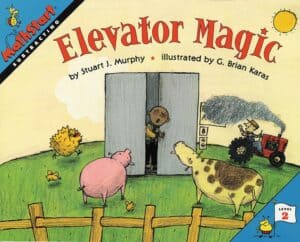
Subtraction comes to life as the character Ben travels down an elevator and opens the door to various scenes. Predicting what comes next adds to fun.
Anno’s Counting Book by Mitsumasa Anno

Great for the youngest mathematicians. Each page adds more details to correspond to a number.
Who Eats First? Ae-he Yoon, illustrated by Hae-Won Yang

Classification, organizing data, and predicting come to life as a variety of animals decide who gets to eat a delicious peach first.
How Many Jellybeans? by Andrea Menotti, illustrated by Yancey Labat

Using candy and great pictures, kids can count large numbers.
100th Day Worries by Margery Cuyler, illustrated by Arthur Howard
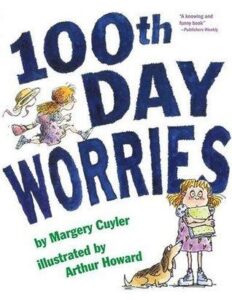
Alice, the main character, needs to find 100 things for the 100th day of school, but she cannot decide what to bring.
100 Hungry Ants by Elinor Pinczes, Illustrated by Bonnie MacKain
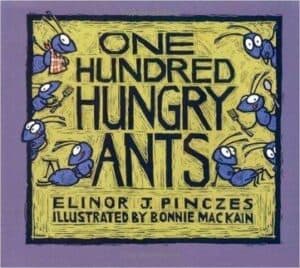
Ants introduce some slightly higher level math concepts including factors, prime and composite numbers, square numbers, and skip counting.
How Much is a Million? by David M. Schwartz, Illustrated by Steven Kellogg

The book offers concrete ways to picture one million. For example, to count from one to a million, it would take about 23 days!
Higher level math skills
The Grapes of Math by Greg Tang, Illustrated by Harry Briggs
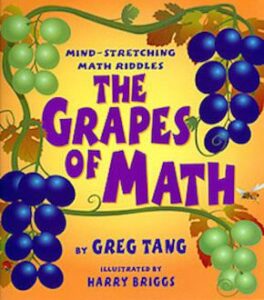
Teach problem solving in a fun and creative way. Visual cues help readers discover new ways of grouping numbers to make then easier to count.
Great Estimations by Bruce Goldstone

This book uses jellybeans to help teach readers how to estimate large quantities of items. With practice and techniques you could win an estimation contest one day!
The Greedy Triangle by Marilyn Burns, Illustrated by Gordon Silveria
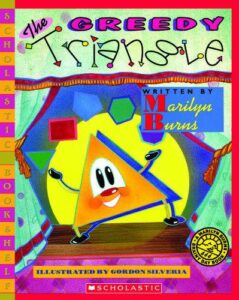
Follow along on an adventure when a bored triangle visits a shape shifter and he starts to grow and change. Readers learn about polygons and angles as a triangle continues to add sides to his shape.
One Grain of Rice by Demi

Readers learn about exponential growth as the main character takes a grain of rice and begins doubling it. The amount of rice quickly adds up.
The Math Curse by Jon Scieszka, Illustrated by Lane Smith

Math is everywhere and readers learn about patterns, fractions and even Fibonacci numbers.
Final thoughts
There are so many fantastic reasons to use picture books to teach math skills. By introducing children to math in non-threatening ways, their attitudes towards the subject improves, they are more willing to engage in math conversations and their classroom performance will improve. But just reading them is not enough. Encourage your kids to ask questions… get them talking! As a bonus, select these books from your local public library (these structures
still exist, right?). Now you are spending quality time with your child and introducing them to a love of reading. After reading a few of them, return to the library and select the next group.
If your child struggles with math concepts, please contact Jennifer Disch at Engage the Brain to discover how a Learning Specialist can help your child discover a love of math by using multi-sensory tools and picture books.

What is driving the mental health crisis in children? And what to do if you suspect your child is struggling.
With apologies to The Who, the kids are not alright. Anxiety, depression, and other mental health issues among children and teens are rising at an alarming rate. Some point to the pandemic as the cause, but a closer look at the statistics reveals that the decade prior to 2020 – and the beginning of the pandemic – children’s mental health had already begun the slippery slide down with emergency room visits up.
According to the Children’s Health Council, a group of medical experts, including the American Academy of Pediatrics, the Children’s Hospital Association and the American Academy of Child and Adolescent Psychiatry, has declared that the mental health crisis in children has become a national emergency. Research backs this up. According to a poll by the Pew research Center on CNN, 40% of parents said that they are extremely or very concerned about their child’s mental health.
To further emphasize the shocking increase, the National Institutes of Health reports that pre-pandemic research in 2015 reveals anxiety disorders in children and adolescents was 6.5% and depressive disorders was 2.6%. Post pandemic anxiety disorders have skyrocketed to 25.2% and depressive disorders shot to 20.5% in children and adolescents.
Further, 42% of high school students in 2021 reported feeling so sad or hopeless for two consecutive weeks that they stopped engaging in their usual activities, which is up from 26% in 2009.
What is causing this mental health crisis?
So what is driving this horrifying and scary national emergency? There is no one single determining factor. According to the American Psychological Association, social isolation, academic disruption, loss of a caregiver, and parent loss of a job are some of the more identifiable causes. Of course these are associated with the pandemic. In addition to those contributors, use of social media, threat of mass violence, natural disasters, climate change, and political polarization are all to blame, too. And for horrible measure, throw in cyberbullying, a focus on body image, and overwhelmed parents.
And if this lousy laundry list isn’t enough, the University of Michigan reports there is a lack of mental health providers. More than half of all U.S. counties lack a practicing psychiatrist. And even if you are lucky enough to live in an area that has mental health professionals, the National Council for Mental Wellbeing is reporting there is an average wait of six weeks for behavioral health services.
Checking on your child’s mental health
Of course you the parent know your child best. When children have good mental health they can quite simply think clearly. They are capable of learning new things – hello school – and carry themselves with a sense of self-confidence. Additionally, they can mange those pesky and difficult emotions such as anger, frustration, and sadness. Finally, they have been taught effective coping skills so that they do not turn to ineffective behaviors such as substance abuse.
Younger children may not have the words to match what they are feeling, so it is important as a parent or caregiver to ask gentle questions. Seattle Children’s Hospital suggests listening more than talking and trying your best to hear what your child may be truly saying. Help younger kids name emotions and feelings. Doing this can reduce their power and impact. Finally, brainstorm coping strategies to help deal with emotions. Model yours! For example, when daddy gets upset he goes out for a walk and thinks about possible solutions to the situation.
Signs of mental health concern
Mental health is tricky and as a parent you need to decide if your child is just having a bad day or if there is something more possibly going on. According to the Mayo Clinic, these are some signs to watch for:
- Sadness, worry, or fear that lasts more than two weeks
- Withdrawing from or avoiding social situations
- Outbursts or extreme irritability
- Changes in eating habits
- Weight change
- Difficulty sleeping
- Changes in academic performance
Of course this is not a complete or thorough list. If you suspect your child is struggling with their mental health, here are some ways to help.
Strategies to help with your child’s mental health
If your child is in crisis, please get them to a doctor or hospital immediately. However, if your child shows one or more of the signs above, here are some ways to help from Very Well Family:
- Show unconditional love
This may seem like common sense, but if your child is struggling or acting out it can be challenging, so double down and love them even more. Hugs and kind words are like a salve for your child’s heart.
- Praise their character
Often times parents go too far and comment and praise every little thing a child does, especially younger kids. Focus your praise on effort and persistence, not the results.
- Spend time together
Again, this may seem like you do this already, but if your teen is in a nasty, irritable mood it can be difficult to seek them out and enjoy a family outing. Find something your family enjoys and do it.
- Communicate regularly
Communication can take many forms, from the obligatory how was your day to something more specific such as tell me the best part of your day. Try to get a conversation going.
- Joyful movement – or exercise they enjoy
There is so much research to back up that movement is good for mental health. Encourage your child to move in a way they enjoy such as swimming or riding a bicycle. Get those endorphins popping!
- Add daily practices
Daily practices such as keeping a gratitude journal, eating healthy meals, and getting the proper sleep are all powerful tools to help promote good mental health.
- Build agency
Prop your child up and share with them how they have handled a negative situation before. Building agency – or that mindset that they do control their outcomes – is so important. With agency your child can be proactive and deal with their concerns.
Final thoughts
The research is clear, and medical professionals are sounding the alarm and have declared a national health emergency. Take a peek at any national publications and you are bound to see a headline with children and mental health crisis in it. Though mental health can be a pejorative term, it is critical that as parents you check in on your child’s well-being. One out of every four of you who read this may have a child in need of help. Know the signs of possible distress and some strategies to help and support your child if you suspect they are struggling.
Engage the Brain supports our students’ mental health by providing academic interventions including Orton-Gillingham instruction for dyslexia, Executive Functioning coaching, and multi-sensory math instruction and, equally importantly, by establishing a relationship built on care and trust with each student we see.

What exactly are 21st century skills? And 7 effective ways they can develop them.
There is a story about a time traveler who arrives in 2024 from the 1800s. He enters a supermarket and is amazed to learn that this is how people procure their food. Next, he strolls along the sidewalk and is shocked to see everyone holding a small device in their hands and staring straight at it. He passes by an airport and is dumbfounded at large metal things taking off and landing with ease. Finally, he steps into a school and feels a sense of comfort and familiarity because school has not changed in almost 200 years.
Schools are grappling with a changing set of skills required of the 21st century worker. The three Rs: reading, writing, and arithmetic are outdated. They have been replaced with a set of skills that better reflect what students ought to be mastering to be successful participants in the 21st century global economy.
21st century skills
The National Education Association breaks 21st century skills into three categories:
1. Learning
Critical Thinking: The Foundation for Critical Thinking defines it as “the intellectually disciplined process of actively and skillfully conceptualizing, applying, analyzing, synthesizing, and/or evaluating information gathered from, or generated by, observation, experience, reflection, reasoning, or communication, as a guide to belief and action.” In other words, the higher order thinking skills that Bloom has defined.
Creative Thinking: Career Services at the University of Pennsylvania defines it as “all about developing innovative solutions to problems. Creative thinkers brainstorm not only a large number of ideas but also a variety and range of them.” Even in math and science classes, creativity is a necessity to go beyond a basic understanding of concepts and creating new applications for these skills.
Collaboration: This is simply two or more people working together to achieve a defined goal. Students need opportunities to practice working in groups and developing the social skills to navigate interpersonal dynamics.
2. Literacy
Information literacy: According to the American Library Association, “Information literacy is a set of abilities requiring individuals to recognize when information is needed and have the ability to locate, evaluate, and use effectively the needed information.” Google has become the new librarian, but this skill goes beyond just a simple Google search. Can a student get the right material in a timely fashion? Can they read it and truly comprehend it?
Media literacy: The ability to critically analyze stories presented in the mass media and to determine their accuracy or credibility. Think of the current climate with political polarization, rise of AI, and the erosion of trust of mainstream media. It is imperative a student develops a sense of when something doesn’t seem right. Can they confirm it with another reliable source?
Technology literacy: SimpliLearn defines it as the knowledge, skills, and abilities required to effectively and responsibly use technology tools, devices, and resources. According toTime Magazine the Educational Testing Service unveiled a new, computer-based exam designed to measure information-and-communication-technology literacy. A pilot study of the test with 6,200 high school seniors and college freshmen found that only half could correctly judge the objectivity of a website.
3. Life skills
Flexibility: The University of Manchester defines it as the ability to change plans, priorities and ideas to suit changing circumstances. This is one of the Executive Functioning skills that so many students struggle with. Being able to “roll with the punches” is a critical skill for students to develop.
Initiative: The ability to work and complete a task without always being told what to do. Someone can think for themselves and take action when necessary. Many students wrestle with this skill, and they need opportunities to put this into practice.
Leadership: Combines many of the life skills; good leaders take initiative, have strong social skills, and are productive. When learning cooperatively in a small group, this provides chances for students to develop this important skill.
The new four C’s
As one can see the original 3 R’s are antiques. According to the University of Massachusetts Global, the New Four C’s are: critical thinking and problem solving, communication, collaboration, and creativity. In a global economy workers must think abstractly, work cooperatively in teams, distinguish good information from bad (or fake), and even speak another language.
20th Century schooling had compartmentalized instruction, that was teacher-centered, with memorization of facts emphasized. 21st Century schooling is student-focused with intertwined disciplines, collaboration and is project-based. And perhaps even more evidence for students to master these 21st century skills is a Department of Labor statistic that indicates that 65% of school-age children today will grow up to have jobs that do not yet exist!
Developing 21st century skills
1. Use your child’s interests. If they are fascinated with flight, encourage them to learn more. Perhaps visit a museum that focuses on flight. Locate websites and or books that share information about the topic. Let them lead the investigation; your job is to support them.
2. Encourage cooperative activities. Kids can learn cooperation in a variety of ways. Playing on a sports team or playing an instrument in the school band or joining Scouts are all great ways to foster cooperation skills. When difficulties arise – the coach doesn’t play your kid, the band director does not want four tuba players, etc. – help them navigate these seemingly difficult circumstances, but do not fight their battles for them.
3. Encourage out-of-the-box-thinking. Challenge your child to come up with a new rule for a familiar game. Maybe they add a twist to Uno or Monopoly. Change the rules during the game to practice flexible thinking. This keeps everyone on their toes!
4. Have your child teach you. There is no shortage of opportunities for children to explain things to their parents. Whether it is how to play Roblox or Minecraft or why a certain YouTuber has 25 million subscribers, ask your child to teach you about these different topics.
5. Participate in challenges. There are many appropriate challenges that can be found online. No, not the Tide pod challenge! More like the egg drop challenge or Balloon Rocket challenge- these fun hands-on activities require your child to think creatively and develop persistence to successfully complete the activity.
6. Focus on transfer of knowledge. How many times has your child come home and complained, “When am I ever going to use this?!” Help your child make those connections. If they are in high school and are studying triangles and the Pythagorean theorem, help them see its use in architecture and engineering design. Explain to them how you use “academic” skills such as reading in your job.
7. Discuss artificial intelligence. There are many AI programs that students may be using right now. Hello, ChatGPT. These programs should not be forbidden; your child needs to learn how to use the tools responsibly and correctly, with your guidance.
Final thoughts
The concept of school is changing. If the pandemic taught us anything, it was that school does not necessarily have to be in a physical building from 8:00 a.m. to 3:00 p.m. Students have options such as virtual school, home school, or even hybrid programs and are free to select the best option for their learning needs. But not only is the school setting changing, so is the curriculum. The 3 R’s of reading, writing, and arithmetic are outdated. In their place are 21st century skills, which include critical thinking and problem solving, collaboration, communication, and creativity. As a parent you can help your child practice these skills. Model them! Remember, your child is probably preparing for a job that does not exist yet.
If your child struggles with school or needs more opportunities to learn these critical 21st century skills, contact Jennifer Disch at Engage the Brain to discover how a Learning Specialist can help.

What exactly is artificial intelligence? And what are the best AI tools for K-12 students?
Parents, buckle your seatbelts! Over the past few years Artificial Intelligence (AI) has grown so rapidly that your high school child can now produce an essay for their English class in less than 60 seconds – not with a command to a Genie or some science fiction contraption – but with one simple visit to ChatGPT. The essay will be well written but may contain a few factual errors. (More on that later.)
Let’s try to understand exactly what Artificial Intelligence is and what it is not. According to Google, AI is a set of technologies that enable computers to perform a variety of advanced functions, including the ability to see, understand, and translate written and spoken language, analyze data, make recommendations, and more. A calculator is not AI because the user must input numbers for the calculator to process the result. The calculator will not “learn” from each entry and predict what the user will enter next. AI will.
Like many industries, education is grappling with the presence and disruption of AI. Some schools and/or teachers are prohibiting its use. Other more progressive schools and/or teachers are acknowledging its existence and are embracing its powers to help students learn.
While there are many viewpoints about AI’s use in educational settings, there are some objective positives and negatives to its place in schools and classrooms.
Positives of AI in education
- According to Forbes, AI-powered educational tools can analyze data on student performance and provide tailored support to improve their grades.
- AI can also provide instant feedback. For example, AI-powered educational tools can provide students with immediate feedback on their work, allowing them to identify and correct mistakes quickly.
- E-learning Industry says AI can personalize learning by tailoring lessons to individual students’ needs, providing immediate feedback, and offering guidance.
- Gamification or the use of game scenarios that interest the students can provide immediate feedback and boost engagement.
- 24/7 access to technology can meet students when and where they are ready.
- Virtual Speech reports that some neurodiverse students who may struggle with traditional settings or learning methods thrive in AI powered environments.
Negatives of AI in education
- Forbes shares that while AI can provide personalized learning and instant feedback, it cannot replace the human and emotional support that students need to succeed, and relying too heavily on AI-powered educational tools may impact students negatively.
- Educators Technology states that plagiarism and factuality of information are also two serious concerns underlying the use of AI technologies in education.
- Privacy concerns proliferate the use of AI – or any internet visit – as students’ personal information can become at-risk.
- Cost of implementing AI in schools can be prohibitive for many districts and schools.
- Some teachers view AI as a threat to their job and may not embrace its true power out of fear for their continued employment.
Best AI tools for students
Now that you have your Cliff Notes version of AI, what are some tools that your child could benefit from using? Below is a wide range of AI apps, websites and programs that can support and enhance your child’s progress in school. Perhaps they are already using some these.
Slidesgo creates slide shows out of Google Slides or Power Point from student content. There are many themes and styles to select from that will “jazz up” any presentation, great for the non-artsy student. Best is that it is free.
Otter.ai records lectures and transcribes them into text in real time. It can even join Zoom sessions and record the meeting. There is a free option or paid options with more features.
Duolingo is a researched-backed approach to learning a foreign language. With bite-sized lessons students earn points and unlock levels, like a video game. And it is free.
Girls Who Code- Code at Home Program is an organization that allows girls to learn computer science and coding- and it is free.
Speechify coverts just about any text to speech. Students can choose from over 100 different voices including Snoop Dog. Prices vary.
Knowji is a tool that helps students learn vocabulary words in a fun and effective way. Using a built-in memory coach, Knowji ensures that each word you learn is maintained and stored in your long-term memory. Students preparing for the SAT or ACT may benefit from this program. Price $9.99.
Cognii: is a virtual learning assistant with conversational chatbot replies. They purport personalized deeper learning and intelligent tutoring among some of the features. Students can ask questions and receive immediate responses in a variety of subjects. Pricing not available.
Plaito is another learning assistant great for homework help and studying. There is a free option.
Hello History allows a user the opportunity to chat with a historical figure or fictional character that responds in their voice and style. It is great for research and learning more about a person. Cost not available.
ChatGPT is perhaps the best known AI tool due to its proliferation in the media. It is a form of generative AI, which means it literally generates responses based on the input. As mentioned at the beginning, ChatGPT can write an essay or tell a joke. There is a free version.
Concluding thoughts
No matter where you sit on the AI knowledge continuum, the education field is being transformed from the various AI applications available to both teachers and students. Like all new and innovative developments, there is a scary element to it along with a wide range of feelings and opinions about it. Positives include the efficiency in which AI can analyze a large set of data and and transform it into recommendations and feedback for student learning. Negatives include the lack of personal connection and emotional support that a teacher or tutor would provide. Whether your child’s school prohibits or embraces AI, these 10 applications are worth reviewing and sharing with your child.
If you have questions about AI or how it could be better harnessed to help your child with their schooling, contact Jennifer Disch at Engage the Brain to learn more about these fascinating programs.

Engage the Brain Learning Specialists are grateful to support students with all types of learning abilities. What are they grateful for away from work?
Practicing gratitude has many benefits. According to Mental Health First Aid, research has shown that consciously practicing gratitude can reduce feelings of stress and anxiety. Studies have found that a single act of thoughtful gratitude produces an immediate 10% increase in happiness, and a 35% reduction in depressive symptoms.
At Engage the Brain, we are grateful for the difference between the words the and a. The Learning Specialists don’t work at a learning center; they work at the Learning Center in Central Florida. (And we just felt a 10% increase in our happiness!) Engage the Brain offers a suite of services unrivaled in the Central Florida region. Specialists are highly trained to support students with a variety of challenges from ADHD and Dyslexia to Speech-Language and Dyscalculia. And if all that is not enough, the North Park Learning Group, a home school hybrid program, is populated with a group of flourishing students.
Gratitude acknowledgements
To put our gratitude practice into action, the Learning Specialists shared what they are grateful for both at work and away from the office.
Jennifer Disch – Founder: I am incredibly grateful to work in an environment that wholeheartedly supports students with all types of learning abilities, and I am equally thankful for the dedicated team of specialists that makes Engage the Brain a comforting, caring, and supportive haven for all.
Outside of work, I am deeply grateful to spend quality time with my family, cherishing the moments that bring us closer together.
Jen Grussaute – Office Manager: I am thankful for Engage the Brain because I look forward to going to work each day because not only are they my coworkers, it’s my work family.
Outside of Engage the Brain I am most thankful for my family and friends and friends that have become family.
Kim Burt – Speech-Language Pathologist: I am very grateful that I have people around me who support me and celebrate my accomplishments and achievements. Many work places do not offer the degree of collaboration, team based mindset and flexibility that Engage the Brain maintains. This makes work much more enjoyable and rewarding.
Having friends and family who are truly available whenever needed is critical to mental health and overall well-being. Knowing I have a “tribe” that I can lean on, and that can lean on me, lessens some of life’s stressors because I know I am not alone in whatever I am going through- challenges and successes.
Sabrina Sullivan – Orton-Gillingham support specialist: We work with a variety of students, and I am thankful to have a team with whom to collaborate and brainstorm.
I am also grateful for my running shoes, which keep me grounded. 🙂
Jenny Wolcott – Executive Functioning Coach: I’m grateful for many things at Engage the Brain. I have wonderful students and co-workers and I’m grateful to have all the resources I need to really provide each student with what they need the most.
Home: I’m grateful to have a wonderful, supportive family that encourages me in everything I do, whether that is changing careers or learning to play the violin. They are always there for me!
Libby Couch – Math Support Specialist: As someone with a non-verbal autistic brother, I’m grateful to be surrounded by a talented team of educators who continuously explore ways to connect with neurodivergent students.
I’m also incredibly happy I have a ceramic studio to create in!
Marla Sullivan – Occupational Therapist: I’m grateful that I can help guide kids towards goals that will help them become more independent. Working in an environment like EtB has given me the creative freedom and support to meet the needs of the kids I work with in the best ways possible.
Something I’m grateful for away from work: My husband and kids. I went back to work this year after staying home for four. They’ve been incredibly supportive and excited for me to jump back into a career I love so much.
Hannah Hartman – Co-Director North Park Learning Group: I am incredibly grateful to see my students learn and grow. Some of our North Park Learning Group students have been with us for years. It has been truly amazing to see them grow in confidence, learn new information, and explore the world around them through the seasons of life.
I am also grateful for the volunteer work I have the opportunity to do with the Winter Park Historical Association. We have just begun planning our newest museum exhibit. It’s a very exciting time!
Final thoughts
Engage the Brain is populated with a variety of professionals with diverse backgrounds who join in the mission of supporting students to help them think, learn, and grow. Each Specialist is grateful for the flexibility given and support received, which helps foster an environment of student success. Engage the Brain encourages our families to practice gratitude and to reap all its wonderful benefits, including reduced depression, less anxiety, and improved sleep.
If your child is struggling in any area of school, please contact Jennifer Disch at Engage the Brain to discover how a Learning Specialist can help your child realize the best versions of themselves and thrive in both the classroom and in life.

How is ADHD actually diagnosed? And what are the most effective treatment approaches?
Attention Deficit Hyperactivity Disorder or ADHD can look different. Perhaps your teenage son’s bedroom looks like a Category 3 hurricane blew through it and he has a magnifying lens on all his emotions. Or your 4th grade daughter seems like she is always daydreaming and needs constant reminders to complete even simple tasks. And of course there could be your middle school son who simply cannot sit still and blurts out information like Alexa on auto repeat, even when not asked.
October is ADHD awareness month (though if your child has it you are probably aware of it 12 months a year!), so Engage the Brain is focusing on sharing some facts, debunking some common myths, and detailing some typical – and not so typical – treatment options.
Dr. Ned Hallowell, a well-know psychiatrist who specializes in ADHD, says, “The ADHD brain is like a Ferrari engine with bicycle brakes.” If your child is like the active – and verbose – child described above, clearly you can relate to this quote. The thinking, processing and output cycle in individuals with ADHD can be disrupted and often times yield undesired consequences.
Types of ADHD/ADD and statistics
According to the CDC, there are three different ways ADHD presents itself, depending on which types of symptoms are strongest in the individual:
- Predominantly Inattentive Presentation: It is hard for the individual to organize or finish a task, to pay attention to details, or to follow instructions or conversations. The person is easily distracted or forgets details of daily routines.
- Predominantly Hyperactive-Impulsive Presentation: The person fidgets and talks a lot. It is hard to sit still for long (e.g., while doing homework). Younger children may run, jump or climb constantly. The individual feels restless and has trouble with impulsivity. They may interrupt others a lot, grab things from people, or speak at inappropriate times. It is hard for the person to wait their turn or listen to directions.
- Combined Presentation: Symptoms of the above two types are equally present in the person.
According to CHAAD (Children and Adults with Attention-Deficit/Hyperactivity Disorder), ADHD runs in families with a heritability chance of 57% for a child if a parent has ADHD and a 70%-80% chance for a twin if the other twin has ADHD. The Centers for Disease Control estimated the number of children aged 3–17 years ever diagnosed with ADHD, according to a national survey of parents, is 6 million (9.8%) using data from 2016-2019. This number includes:
- 3–5 years: 265,000 (2%)
- 6–11 years 2.4 million (10%)
- 12–17 years: 3.3 million (13%).
Additionally, according to a national 2016 parent survey, 6 in 10 children with ADHD had at least one other mental, emotional, or behavioral disorder:
- About half of the children with ADHD had a conduct problem.
- About 3 in 10 children with ADHD had anxiety.
Myths about ADHD
Like so many conditions and diseases and maladies, there is a plethora of information available just a few finger clicks away on the internet. Hello, Dr. Google! While some of that information is truthful and perhaps even helpful, much of it is wrong and can be even dangerous depending on the disorder. To help parents sort through what information belongs in which category, what follows are several common myths about ADHD and related facts.
Myth: A child’s environment is the main cause of attention deficit disorder. If you make changes to the home environment, the condition will solve itself.
Fact: ADHD is a legitimate brain processing condition. The environment could be perfectly set up to support a child with ADHD and there could still be challenges.
Myth: ADHD is not a real medical condition.
Fact: Understood states that The National Institutes of Health, the Centers for Disease Control and Prevention, and the American Psychiatric Association all recognize ADHD as a medical condition. Imaging studies show differences in brain development between people with ADHD and people who don’t have it.
Myth: All children with ADHD are hyperactive.
Fact: As referenced above, there are three ways the condition can present itself. One is predominantly inattentive. Think of the daydreamers or child who needs multi-step directions repeated numerous times.
Myth: Children with ADHD will outgrow it.
Fact: According to the Child Mind Institute, about two-thirds of kids with ADHD will continue to meet the criteria into adulthood. But the symptoms can change. Often the hyperactivity component can lessen as a person matures into an adult.
Myth: Only boys have ADHD.
Fact: Twice as many boys are diagnosed with ADHD than girls. That typically is attributed to girls not being hyperactive, which tends to be more visible – and disruptive – in childhood. Often with girls the symptoms are missed or overlooked by classroom teachers who are not trained or experienced in working with students with ADHD.
Diagnosing ADHD
There’s no single test to diagnose ADHD. A psychologist or psychiatrist or a primary care provider such as pediatrician can diagnose the condition. According to Wedmd, doctors rely on several things, including:
- Interviews with the parents, relatives, teachers, or other adults
- Personally watching the child or adult
- Questionnaires or rating scales that measure symptoms of ADHD
- Psychological tests
ADHD ratings scales are commonly utilized during the diagnosis process. Parents and teacher(s) will be asked to fill out a questionnaire. Healthline has some great information about the rating scales and what to expect when completing them.
Treatment options for ADHD
Just as no two people with ADHD share the exact same symptoms, there is no universal treatment perfect for all. According to Nemours Kids Health, treatment for ADHD usually includes:
- Medicine. This activates the brain’s ability to pay attention, slow down, and use more self-control.
- Behavior therapy. Therapists can help kids develop the social, emotional, and planning skills that are lagging with ADHD.
- Parent coaching. Through coaching, parents learn the best ways to respond to behavior problems that are part of ADHD.
- School support. Teachers can help kids with ADHD do well and enjoy school more.
While medicine, therapy, and coaching are the most common approaches to addressing ADHD, there are alternate treatment options.
- Diet: The Feingold Diet is an elimination diet, which strives to remove certain foods to help reduce hyperactivity and increase focus.
- Exercise: CHAAD states that 30 minutes of aerobic work: running, biking, swimming can be as effective as taking medication.
- Yoga: My Yoga Teacher shares ten poses to help with focus and attention.
- Meditation: Five techniques to get started by Choosing Therapy.
Final thoughts
ADHD is a legitimate brain condition which can present in three different ways: predominantly inattentive, predominantly hyperactive and impulsive, or a combination of the two. Diagnosing it requires a medical professional such as a pediatrician or psychiatrist who will use a variety of techniques including observation, interview, and rating scales. Treating ADHD is most effective when employing a holistic approach, using a combination of tools including medicine, diet, and exercise. Perhaps the most important action to take when a child has ADHD is to surround them with the right support system. Dr. Hallowell, the psychiatrist who focuses on ADHD, says, “You need to give what’s best in you a chance to grow with the right gardener, one who sees that you’re a special plant, not a weed.”
If your child has been diagnosed with ADHD or you believe your child is struggling with symptoms similar to it, please contact Jennifer Disch at Engage the Brain to discover how a Learning Specialist may be able to help provide your child with strategies and techniques to help them thrive in the classroom and life and blossom into the best versions of themselves.

What are the benefits of creating an after-school routine for children? Some include lower stress levels for kids and their parents. Here is a how-to for creating one that works for your family.
When kids arrive home after school, things can go a lot of different ways. Some children have a supportive parent waiting with a healthy snack and an eager ear to hear about all the wonderful things that they learned in school that day. Other kids wander into an empty, silent house, due to both parents working to make ends meet. And of course there is the child who may (or may not) have kept it together all day at school, only to arrive home to a parent who knows the meltdown is coming once their child is safely in the home.
No matter what your after–school time looks like in your family, there is a secret to a successful transition for your kids from school to home: establish an after-school routine.
Why establish a routine
There is a lot of research that supports how beneficial it is to create a routine for children to follow. According to the American Psychological Association, a recently published review of 50 years of psychological research shows that even infants and preschoolers are healthier and exhibit better-regulated behavior when there are predictable routines in the family.
Penn State University adds that children feel more confident and secure when their daily activities are predictable and familiar. Structure in the form of routines can reduce struggles and provide a safe and secure environment for children.
Doesn’t this sound enticing? Less stressed kids and fewer struggles with chores and homework! In addition to these fantastic benefits, children will develop skills and responsibilities. While your child balances completing homework, chores, and any extracurricular activities, they will also be practicing an important Executive Functioning skill of time management.
How to make an after-school routine
If the word “routine” makes you shudder due to its rigidness and connotation of falling in line, then consider creating an after school ritual. Dr.Erika Bocknek, Associate Professor of Educational Psychology at Wayne State University, discusses the importance of creating a routine and ritual. Dr Bocknek says, “Rituals give children a growing sense of themselves as a member of a greater whole which promotes positive developmental outcomes. In addition, the joy that families experience inside of rituals together can leave an ‘emotional residue’ that children keep with them to cope during stressful times.” She cites examples of rituals such as Taco Tuesday or a bedtime routine of reading a favorite story.
Where should you start? Do not Google “after-school routine” looking for an easy one already created by some super mom who blogs about how wonderful her family life is and offers free downloads if you enter your email address. Do not do this because your kids are not her kids! Every family is going to have unique needs and the after-school schedule you create must work for your home.
First, let kids help make the routine; they will be more likely to follow it. Of course you will drive and steer the process so that the schedule includes all of the necessary ingredients discussed below.
Next, include a snack time. Depending on the age of your child, lunch at school could be extremely early and they may have not eaten in hours. Of course you will want to offer healthy choices to refuel their bodies and minds.
After that, it is homework time. Having a predictable homework time and location to complete it reduces fights and pleas to skip it. If your child is older and has hours of homework – (yikes!) – break up the homework time with brain breaks and maybe even with some exercise, which is discussed next.
Add in exercise and/or movement. Many students simply need to move to get out some excess energy. Department of Health and Human Services (HHS) estimates that only 1 in every 3 children in America participates in physical activity every day. It is important to note that these pieces of an after-school routine are not necessarily listed in order. If your child needs to exercise immediately upon arriving home from, honor that need and allow it.
Allow time to decompress. All students benefit from time to just chill. Discourage screen time and video games during this part of the schedule. Simply relaxing and doing nothing can actually spark creativity and recharge the batteries. If your child needs to move, encourage yoga as a way to decompress yet still reap some physical benefit.
Finally, provide screen time and access to video games. If your child has accomplished all of the above steps in the routine, then they have earned some time to play a video game or watch a show on tv, if those are activities that interest them.
Make sure to post the routine so everyone can see it and follow it. Printing out and posting the routine in a high visibility location such as the kitchen or an entry way is great idea and reminder that there is a routine to be followed. Remember: Kids need support while learning the new routine(s); don’t expect them to magically just follow along. Look for small improvements and praise the effort, not the result.
One final note: Children’s Hospital of Orange County reminds parents to look out for your well-being too. Parenting can be both wonderful and stressful. Establishing a family routine will help you too!
Final thoughts
When children come trudging into the house after school, things can go many different ways. Some kids are exhausted and are looking for a comfy place to crash, while others are wound up like a spin toy with the spring about to pop. Whatever your child looks like when they arrive home from school, having an established and well rehearsed routine will help with the transition from school to home. While the exact order of the schedule does not matter, the important components include a snack, homework, exercise, downtime, and finally access to screens if desired.
If your child struggles with transitions from school to home – or struggles with transitions in general – contact Jennifer Disch at Engage the Brain to discuss how an Executive Function Coach may be able to help.

What exactly is a growth mindset? And 5 strategies for parents to develop one in their child.
“One should not pursue goals that are easily achieved. One must develop an instinct for what one can just barely achieve through one’s greatest efforts.” —Albert Einstein
Albert Einstein was a brilliant scientist and mathematician. But with this quote he could have defined what a “Growth Mindset” is years before the term became popular in education circles. The concept of growth and fixed mindsets was coined by psychologist Carol Dweck in her 2006 book, Mindset: The New Psychology of Success.
According to Dweck, a Growth Mindset is the belief that a person’s most basic abilities can be developed through dedication, hard work, and practice. On the other hand, people with fixed mindsets believe that intelligence and skills are innate, and that whatever strengths or deficits you are born with, stay with you for life.
Put another way, people with a growth mindset understand effort is required to succeed, they accept (constructive) criticism, and persevere during times of struggle. Those with fixed mindset characteristics fear failure, avoid challenges, ignore feedback, and give up easily.
Parents: which better describes your child?
Dweck says, “If parents want to give their children a gift, the best thing they can do is to teach their children to love challenges, be intrigued by mistakes, enjoy effort, and keep on learning.”
What the research says
One can go down the proverbial rabbit hole when researching any topic, from what the Baywatch beauties look like today to whether Big Foot was actually spotted in the Oregon woods. But the research on the effectiveness of growth mindsets is fascinating. Perhaps a good place to start is with a definition of intelligence. If you define intelligence as brain processing speed and memory, then those particular cognitive abilities tend to stay fixed. However, if you choose to broaden the definition to include knowledge and skills, then we can improve these commodities.
Intriguing is the research into brain plasticity, which is a process that involves adaptive structural and functional changes to the brain, according to the National Library of Medicine. In an article on Mindset Works, it states: “Research on brain plasticity has shown how connectivity between neurons can change with experience. With practice, neural networks grow new connections, strengthen existing ones, and build insulation that speeds transmission of impulses. These neuroscientific discoveries have shown us that we can increase our neural growth by the actions we take, such as using good strategies, asking questions, practicing, and following good nutrition and sleep habits.” This is a significant piece of research worthy of sharing with children: Your brain can change!
Finally, research shows that developing a growth mindset and building grit is critical to success. In fact, according to the researcher Jennifer Bashant, grit and perseverance and self-discipline are better predictors of success in college than SAT or IQ test scores.
Strategies and techniques to develop a growth mindset
Now that you are 100 percent on board with the importance of creating a growth mindset in your child, what follows are some researched-back strategies and techniques to help guide you.
1. In Big Life Journal there is a wonderful article dedicated to teaching about neuroplasticity. Some of the suggestions include:
- Teaching your child about the brain and its basic functions. This video is a great place to start.
- Sharing amazing facts such as there are as many neurons in the brain as there are stars in the Milky Way: about 100 billion!
- Celebrating mistakes because this is how the brain grows!
2. Another powerful way to develop a growth mindset is to use certain phrases with your child while avoiding other ones. Positive Psychology has a complete list of suggestions that includes:
- Instead of saying “You are so smart!” say “You worked so hard!”
- Instead of saying “You are so clever!” say “I like how you persevered on that problem.”
3. Remember to be a role model. Think aloud how you problem solve or work you way through a concern in your life.
4. When your child is struggling with a problem or situation, ask questions. (Avoid being the bulldozer parent who jumps in solves the problem.) Ask: What is your brain saying? What is the hardest part? What are some challenges you have already overcome?
5. Introduce the Power of Yet. Yet is a small word but packs a punch with possibilities:
- I can’t do this… yet.
- This doesn’t work… yet.
- I am not good at this… yet.
Final thoughts
Fostering a growth mindset in your child is critical for both their school success and, more importantly, for your child to thrive as an adult 10 or 15 years down the road. Inevitably, the ups and downs of life are going to come and confront your child. Armed with a growth mindset, your child will have strategies and techniques to address these challenges and thrive in the face of adversity. By teaching your kid about brain plasticity, carefully wording your praise, and employing the power of yet, you will put your child in the best position to flourish now and in the future as a positive contributing member of their adult community.
If your child struggles with a fixed mindset or you need help developing a growth mindset in your child, contact Jennifer Disch at Engage the Brain to discover how a Learning Specialist could help.

How can parents help their child avoid summer learning loss? By engaging in the following fun reading, writing, and math activities.
Well parents, we have reached the middle of the summer, a time of reckoning for many caregivers. That relaxing schedule and family time you were craving back during the school year has come in earnest. Some of you may even be peeking ahead and secretly hoping August arrives soon, bringing with it the start of the next school year. While the summertime daily routine is hopefully more laid back, many of you may be staring at your kid(s) – and perhaps at an adult beverage off in the distance – and asking, “How do teachers do it all day with 20 of these in the room?”
Engage the Brain is here to save the day – and your sanity – by offering up some educational activities to keep your child’s brain sharp and to help avoid the dreaded summer slide or learning loss that occurs when kids do not engage in reading, writing, and math over the summer months.
There are a slew of studies and statistics to support this. A Brown University study revealed the average student in grades 1 through 8 lost 17% to 34% of the prior year’s learning gains during summer break. Another study conducted by Brookings found that math declines were sharper than reading, with the extent of loss being more significant at higher grade levels. And children from low-income families are nearly three grade equivalents behind wealthier students in reading by the end of the fifth grade due to summer learning loss.
Of course summer ought to be a time to ratchet down schedules and structured learning, but that does not mean to turn it off completely. Asking a child to read during the summer can become a battle, especially with competition coming from screens and peers.
So what is the answer? How do you stave off summer learning loss and give your child time to recharge their learning and personal batteries? By presenting fun activities that mask the learning and sneak in skills your child will not realize they are practicing or will be having so much fun they will not care.
Engage the Brain scoured the Internet and curated the best summer learning activities and divided them into three categories: reading, writing, and math. They can be selected a la carte, and most require little preparation. Grab your child, pick a subject and an activity, and enjoy!
Reading activities
Keep a loose schedule: While it is summer, it is easier for your child to fall into a routine if you plan to have a reading time at about the same time every day. Perhaps there is a comfy area in the house where your child can sprawl out, relax, and read for 20 to 30 minutes.
Be a good role model: Try to set a good example by putting your phone down, stepping away from the computer, and picking up a book or magazine to read. It truly is powerful for children to see you doing what you are asking them to do.
Weekly trips to the library: Make a trip to the library extra special by pairing it with a festive treat after selecting books. Each week could be a different type of treat, such having a picnic lunch (in the family room, if needed, to beat the summer heat), stopping at a comic book shop, breaking out brand new sidewalk chalk for some driveway/sidewalk art, enjoying homemade smoothies or ice pops, or going home to build a fort to enjoy family reading time in.
Read aloud: Not every reading session needs to be your child reading by himself. Children of all ages – yes, even middle schoolers! – enjoy listening to a story. Ask about characters, setting, and the problem of the story as you read.
Partner read: Similar to reading aloud, take turns with your child reading a story. You read one page, and she reads the next. As mentioned above discuss the story elements.
Have your child read aloud to someone else: Sometimes reading aloud to someone else is motivating for a child. With FaceTime and Zoom easily accessible, set up a time for your chid to read to a grandparent, aunt or uncle, or heck, even their pet.
Try nonfiction topics: Not every child likes fiction. Introduce nonfiction topics your child is interested in learning about. Biographies of famous people from an area your child is interested in can be good choices. Pro athletes, scientists, history of tanks, rock stars, all make good reading topics.
Play board games: There are many great games that promote literacy and vocabulary development that kids love to play. Several examples are Scrabble, Boggle, and Bananagrams.
Children’s Cook Book: When this writer was young (and hated to read) my mother bought a Winnie the Pooh cook book, which contained some delicious recipes with easy steps. Sneakily, she asked me to read the directions while we prepared a snack – no doubt something with honey. Whatever your child’s interests are- from Minecraft to Harry Potter to Star Wars to science experiments- there is certainly a cookbook associated with it.
Audio books: Audio books have their place, especially if your child has a learning difference. It is recommended that you have the physical book so your child can read along, matching the sounds of language to the printed word.
Supplement a book with related activities: After reading a book about a specific topic, head out to a location that has some connection. Perhaps you could go to a museum, a park, a concert, or some other place that is related to the book. Help your child connect the written word with the world around them.
Writing activities
Extend the story: They lived happily ever after… or did they?! After finishing a book, challenge your child to come up with a new ending or better yet, extend the story with a new chapter.
Book vs Movie: Comparing a book to its movie counterpart can be motivating to your child. Use a simple Venn diagram to compare and contrast the movie and book. Then have your child draft a paragraph either on paper or on a computer.
Write to a favorite author: Today there are lots of ways to contact an author through their own websites or on social media. Many of them will write back, creating a thrilling keepsake for your child.
Round Robin stories: One person writes the first sentence of a story, then the next person adds one sentence. If there are more than two people, then each person adds one sentence before the story returns the first person, who keeps it going. Review story structure: characters, setting, plot, climax, resolution. Encourage your child to move the story forward.
Social Media journals: Social media is everywhere and your child may either be on one or views one daily. Use this to your advantage. Your child can create posts/updates as if they are the character from a book or the author promoting the book. Look online at examples of actual posts by authors.
New word collection: A fun way for your child to build their vocabulary is by starting a new word collection. When she reads or hears a new word, she can write the word and a definition in a journal or special notebook. Over time she will have a nice study guide for the SAT!
Create comic strips: Some children will enjoy the creative process of developing a comic strip. He can use existing characters or make up his own. He can use a blank three panel or six panel comic strip organizer.
Write fan fiction: A popular literary activity is for people to write fan fiction. It is essentially a person trying to copy the style of their favorite author. There are websites devoted to most popular writers that your child can read to develop some inspiration.
Create your own MadLibs: Most kids love filling out MadLibs. Ask your child to create her own. It reviews parts of speech and usually ends with a room full of belly laughs.
Math activities
Sidewalk chalk number lines: Get the kids outside and use sidewalk chalk to create number lines. Depending on your child’s age, the lines could count by 5s, 10s, 100’s, etc. For older children, challenge them to divide a line into fractions such as thirds, fourths, or even tenths.
Lego math: Legos are popular toys found in many homes. Use your child’s natural love of creating with Legos and challenge them to build a structure then find its area (length times width); its perimeter (distance around the outside); and volume (how many Legos they used).
Math walk: Another great activity to get the kids moving. Take a walk around the neighborhood – or go to a local park – and encourage your child to look for math related concepts. Examples include looking for shapes, angles, symmetry, and numbers.
Grocery shopping: Unfortunately (or fortunately) grocery shopping is a weekly – or more often – task in most households. There are many opportunities to get math involved with the process. Ask your child to look for coupons and calculate the savings. Another fun thing to do is give your child a pretend budget and challenge them to “purchase” items that come as close as possible without going over the budget number. And yet another math game is to have your child estimate cost of total of the bill. Encourage rounding as a way to base their estimate.
Car trips: Driving in the car can also provide some great opportunities to practice math. Have your child estimate the distance of the trip or predict how long it will take to get to your destination. No cheating with Google Maps on their phone!
Create 2-D and 3-D shapes: Using craft sticks and PlayDoh your child can build 2-D shapes such as rectangles, pentagons, and octagons. Up the challenge and ask them to make 3-D shapes such cubes and rectangular prisms. Discuss faces (the sides), vertices (the corners), and edges (where two sides meet).
War Card Game: A great way to practice basic math facts is to play the traditional card game War with a twist. To play the game two players split the deck of cards evenly, or 26 cards each. Each flips over two cards facing up. They each either add or multiply the two cards – pick one operation for each round of the game. The player with the higher answer keeps the four cards. Players flip over two more cards each and repeat. If there is a tie or equal answer, players flip over two more cards and the highest total from that flip wins all the cards.
Popular apps and websites: While the goal of this list of math activities is to get your child off their device and explore numbers and math concepts in the real world, there are many wonderful apps and websites that children love to use. A few of our favorites are: Prodigy, Khan Academy, ReflexMath, and SplashLearn, which is good for K-5.
Final thoughts
Summer learning loss is real and every child experiences it unless they engage in reading, writing, and math activities over the summer. Completing a few worksheets does not solve the problem. Children must use critical thinking and truly invest in an activity for it to produce real results. Select an activity each day to enjoy, and your child’s learning loss will turn into a learning gain, positioning them for success on the first day of the school year and beyond.
If you feel your child needs assistance with reading skills, written expression, or math concepts, please contact Jennifer Disch at Engage the Brain to discover how a Learning Specialist may be able to help your child prepare for the new school year.